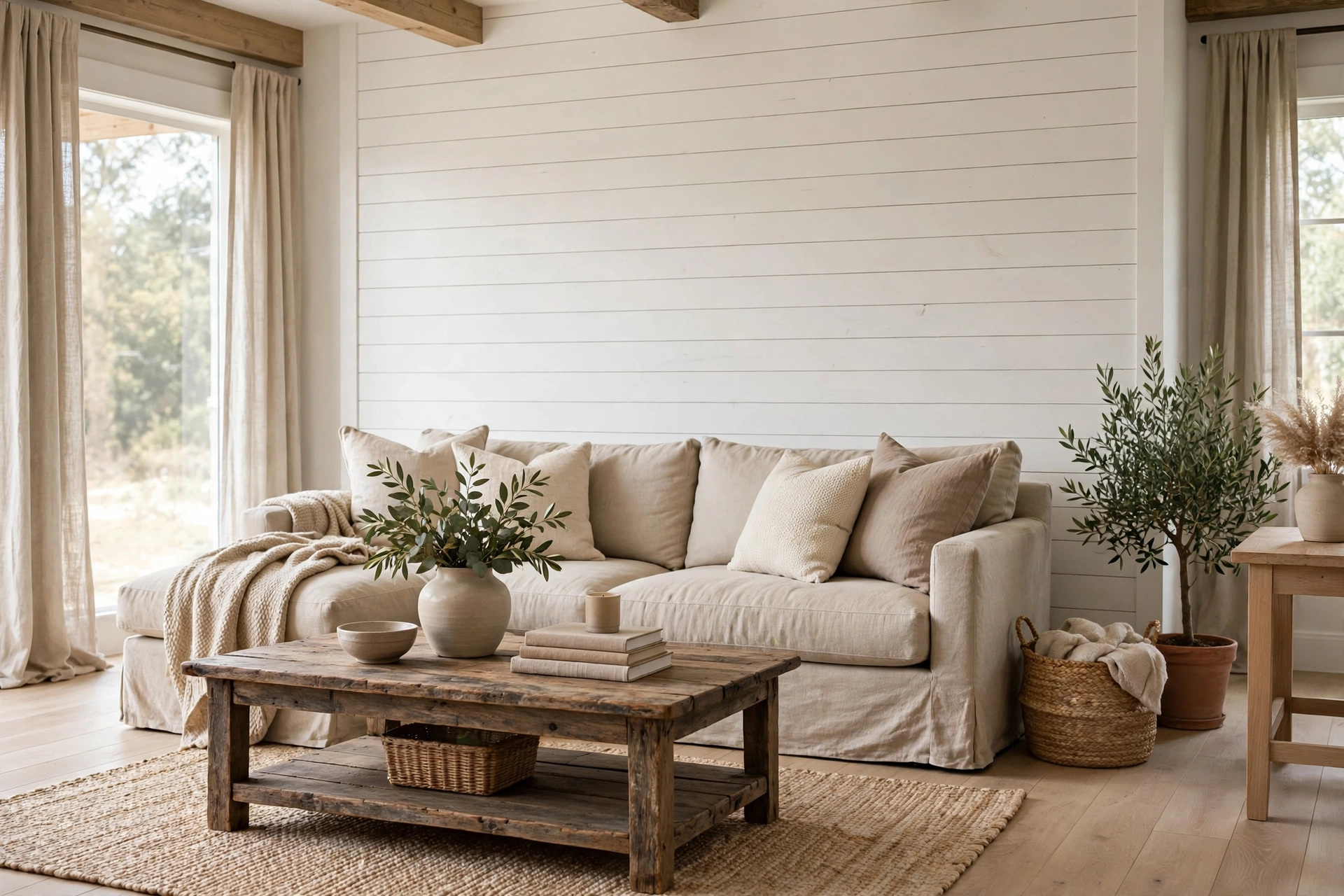
A modern farmhouse living room feels warm the moment you walk in, and it does so without trying too hard. The style is relaxed rather than rustic: clean lines and open space, softened by real wood, natural linen and one or two pieces that look as though they have been there for years. It is not a farmhouse museum, and it is not a showroom either. The trick is the balance — modern enough to feel fresh, farmhouse enough to feel lived in.
This guide works through the room in the order that matters. Start with the bones — the walls and the floor — then the wood, then the sofa, then the textiles, then the few old pieces that give the room its character. Most of the ideas below cost little or nothing, because farmhouse style is mostly about what you choose to keep simple and what you choose to let age gracefully. A room that looks collected over time cannot be bought in one afternoon, but it can be started in one.
Start with warm neutrals, not bright white
Modern farmhouse colour starts warm. A warm white, a soft cream or a pale greige on the walls gives the room its glow, and it flatters wood far better than a cold, bright white. In a north-facing room a warm white keeps the walls from going grey in the evening; in a sunny room it softens the glare without dulling the light. Test a patch on the wall opposite the window and live with it for a few days before committing to the whole room.
Keep the palette narrow: three neutrals and one accent. Warm white on the walls, a natural linen tone on the sofa, a mid-tone wood on the floor, and one muted accent such as sage green, dusty blue or a soft terracotta. One accent, repeated in two or three places, is enough. Two competing accents make the room look decorated rather than collected, which is the opposite of the farmhouse feeling.
If the room already has a strong wall colour, you do not have to repaint everything at once. A single warm neutral wall behind the sofa can reset the room, and the rest can follow when you are ready. The same thinking runs through our small living room design ideas, where one calm background colour makes a compact room feel larger — in a farmhouse room that calm background is what lets the wood and linen do their work.
Use shiplap as an accent, not a costume
Shiplap is the most recognisable farmhouse feature, and the easiest to overdo. One wall is usually enough: the wall behind the sofa, or the fireplace wall, or a short stretch in an entry nook. A whole room wrapped in shiplap stops looking like a home and starts looking like a set, and it also makes the room feel smaller than it is.
Keep the shiplap the same warm white as the walls, or a shade lighter, so it reads as texture rather than as a pattern. Painted shiplap in a soft cream gives the wall depth in daylight and a quiet shadow line in the evening, without shouting about itself. If you are renting, or you do not want to fix boards to the wall, a single tall plank panel leaning behind a console, or a shiplap-look panel on one section, gives much of the same feeling with none of the commitment.
Balance the horizontal lines of shiplap with something vertical nearby — a tall plant, a floor lamp, a long mirror — so the wall does not feel like a stripe across the room. The contrast keeps the eye moving and stops the shiplap from flattening the whole wall into one band.
Let the wood do the talking
Wood is the material that makes a farmhouse room feel honest. Reclaimed wood, with its marks and uneven tone, brings a history into the room that new wood cannot fake. A reclaimed wood coffee table, a beam over the fireplace, or a single thick shelf in a warm mid-tone is often all the room needs. The rest of the wood — the floor, the side tables, the legs of the chairs — should stay quieter, so the one reclaimed piece can be the star.
Mix wood tones deliberately, not accidentally. A light oak floor, a mid-tone walnut coffee table and a dark wood frame on one mirror can work together when one tone clearly leads and the others support it. Three woods of equal strength, with no clear leader, make the room look as though the furniture arrived from three different houses. Choose the dominant tone first, then let the rest follow it.
Keep the finish matte and the grain visible. Farmhouse wood looks best when it is not glossed over: a waxed or oiled surface, a little wear on the edges, and no heavy varnish. If a piece you already own is dark and shiny, a linen runner, a stack of books, or simply moving it out of the main sightline can soften it without replacing it.
Choose a sofa you can actually live on
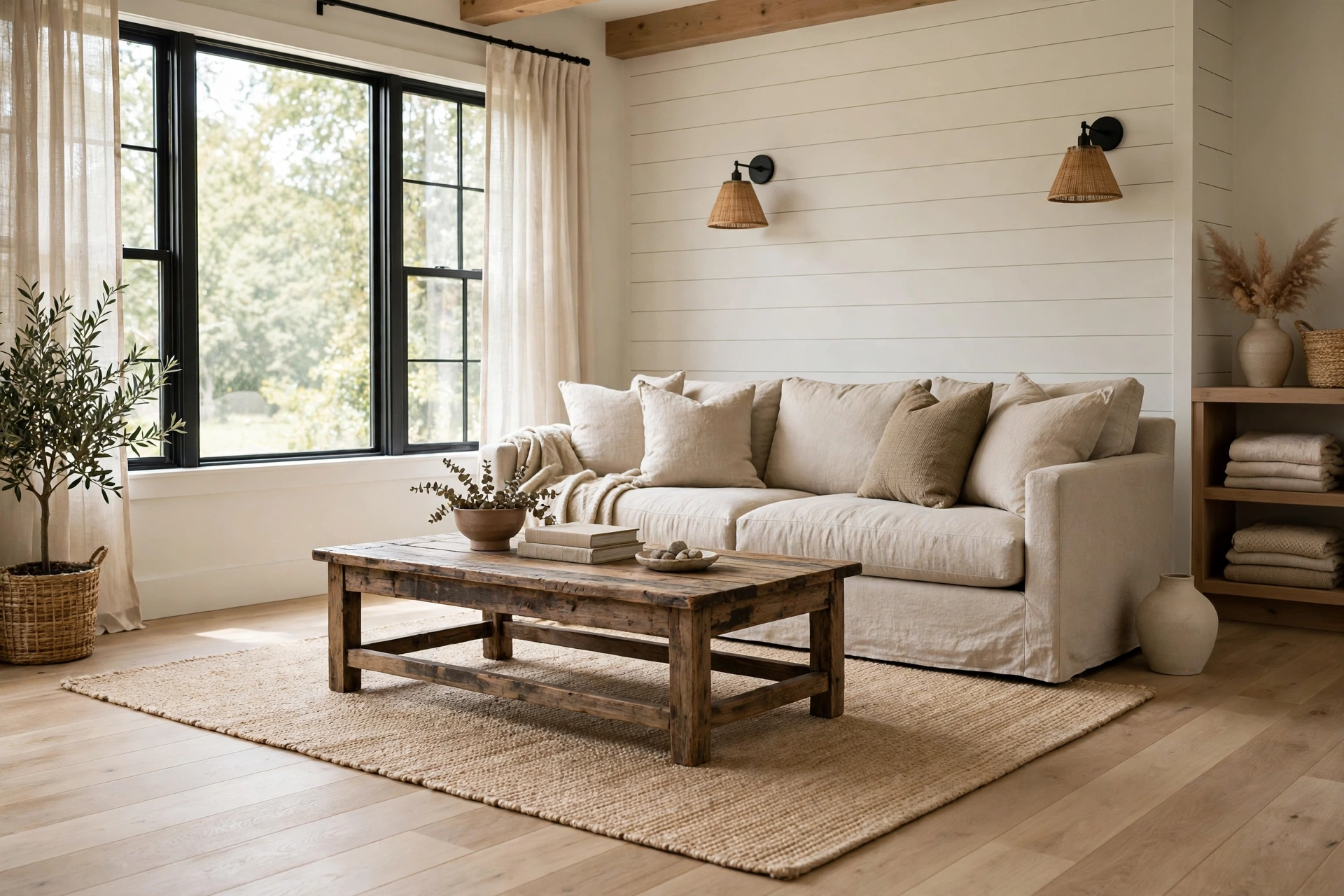
The farmhouse sofa is deep, soft and plain. A linen or cotton slipcovered sofa in a warm neutral is the classic choice, because it can be washed, it softens with age, and it never looks too precious to sit on. Slim, tailored arms suit the modern half of the style; a deep seat and a low back suit the farmhouse half. Together they make a sofa that looks relaxed and still holds its shape.
Check the seat depth before you buy. A seat depth of about 22 to 24 inches suits most people for sitting upright and curling up alike, while anything much deeper turns the sofa into a bed that nobody can sit on properly. The same care with scale applies to the whole room, as our Scandinavian living room ideas show in the opposite direction — pale and minimal where farmhouse is warm and layered, but just as strict about furniture that fits the people who use it.
Place the sofa so it faces the room, not the wall. A farmhouse living room is a room for talking as much as for watching, so the sofa should face a chair or two across the coffee table, with enough space between them for a tray of cups. If the television has to be in the room, put it where it does not dominate the seating, and let the fireplace or the window be the real centre of the room.
Layer linen, cotton and wool
Textiles are where a farmhouse room gets its softness. A linen throw over the arm of the sofa, cotton cushions in a plain weave, a wool blanket folded over a chair — each layer adds texture without adding pattern. The style uses texture instead of fuss: a slubbed linen, a chunky knit, a woven rug, a cotton curtain that hangs straight and plain. A room with five textures and no pattern feels rich. A room with five patterns feels busy, however warm the colours are.
Keep the textile colours close to the room: cream, oatmeal, soft grey, warm beige, and the one muted accent you chose for the walls. A sage cushion and a terracotta throw in the same room are two accents competing, not one accent working. Choose the accent you like most, repeat it in two places — a cushion and a throw, for example — and leave the rest plain.
Let the textiles look used. Linen is supposed to wrinkle a little, wool is supposed to look soft rather than crisp, and a cushion that is always perfectly plumped looks more like a shop display than a home. The farmhouse feeling comes from things that are comfortable first and tidy second, and the textiles are where that shows most clearly.
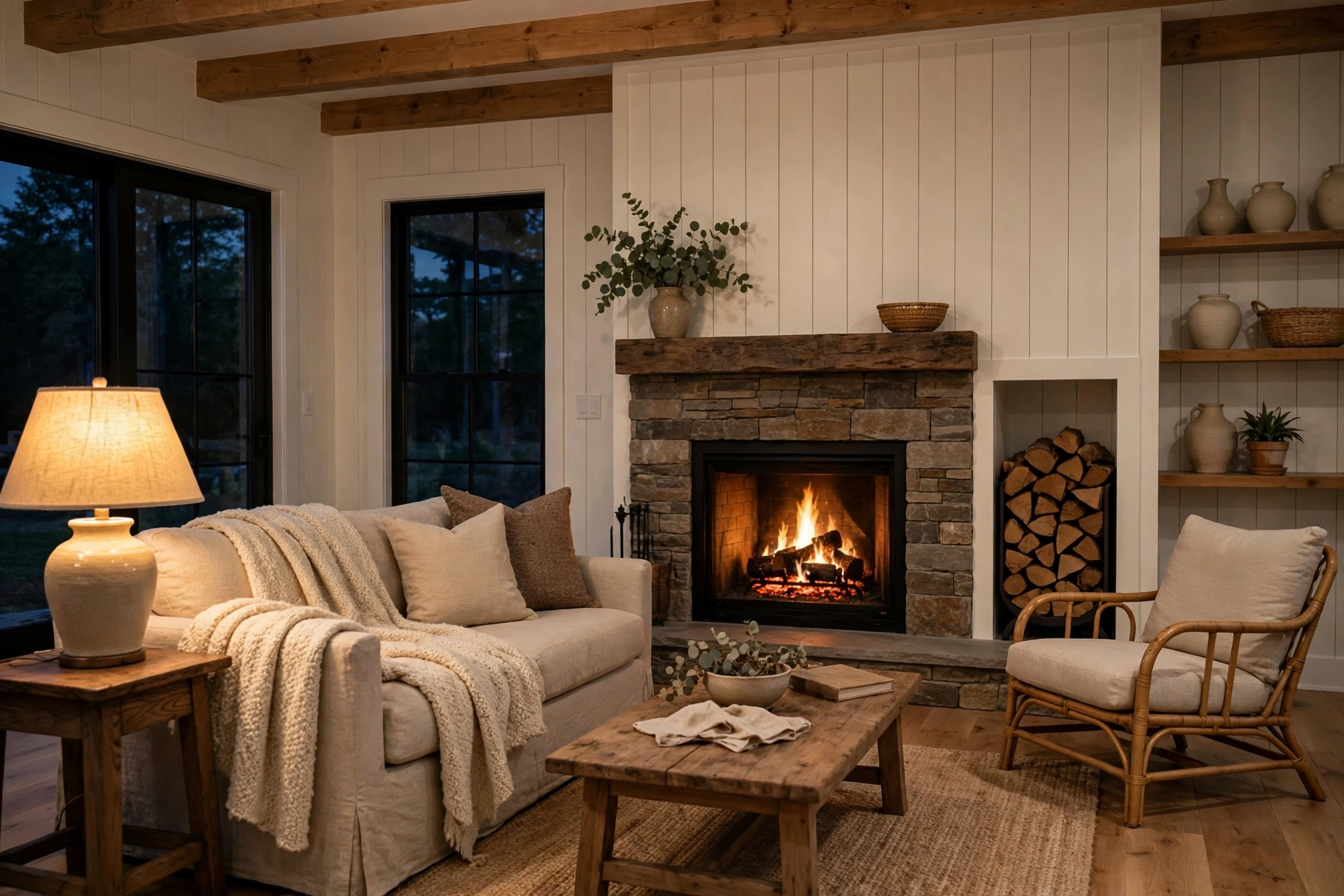
Add one vintage piece, not a collection
Every good farmhouse room has one piece with a past: an old wooden trunk used as a coffee table, a vintage mirror with a worn frame, a set of enamel jugs on a shelf, or a single antique chair that does not match anything else. One such piece gives the room a story. Five of them turn it into a shop.
Choose the piece for what it does, not just for how it looks. A trunk that stores blankets is better than a trunk that only sits there; a vintage ladder that holds throws is better than one that holds nothing. When an old piece has a real job in the room, it stops looking like decoration and starts looking like it belongs there.
If you have no vintage piece yet, do not rush to buy one. A plain wooden crate, a second-hand basket, or a frame found at a market can be the start, and the room will tell you what it still needs once you live in it for a while. The collected look is collected over time, and a room that waits for the right piece always ends up better than one filled in a single weekend.
Keep the coffee table low and useful
The coffee table is the centre of a farmhouse living room, so it should be low, solid and useful. A reclaimed wood top on simple legs, a trunk with a flat lid, or a plain oak table with a lower shelf all work. The table should be about two-thirds the length of the sofa and low enough that a cup set down on it does not block the view across the room.
Style it lightly and leave most of it empty. A stack of two books, a small vase with a few stems, and a candle is enough. A table covered edge to edge with objects is not a farmhouse table — it is a display shelf, and it leaves nowhere to put a cup down. The empty space on the table is part of the design, not a gap waiting to be filled.
Under the table, a plain woven rug in a natural tone ties the seating together. The rug should be large enough that the front legs of the sofa and the chairs all sit on it; a rug that is too small makes the whole seating group look as though it is floating. A flat weave or a low pile suits the style better than a deep shag, which fights with the clean lines of the rest of the room.
Light it warm, in layers
Farmhouse lighting is warm and layered, never a single bright ceiling light. A table lamp with a linen shade, a floor lamp beside the reading chair, and a few candles or a low pendant over the coffee table give the room three levels of light, and each one can be used on its own. In the evening, the lamps do the work; the ceiling light is for cleaning, not for living.
Choose warm bulbs and linen or cotton shades, which soften the light instead of throwing it hard across the room. A bare bulb or a cold white light undoes the warmth of the wood and linen in seconds, however good the furniture is. If the room has a fireplace, let it be the fourth layer of light on cold evenings — a lit fire does more for a farmhouse room than any lamp can.
Keep the fixtures simple: black metal, aged brass, or plain wood, with no crystal and no chrome. The fixture should disappear into the room and leave only its light behind. Our Japandi living room ideas make the same point in a quieter register — light as a layer, not a single source — and in a farmhouse room that layering is what turns warm colours into a warm feeling.
Style the shelves like a home, not a shop
Open shelves suit farmhouse style, but only when they hold things the household actually uses. A shelf with a stack of books, a jug, a plant and one framed photograph looks like a home. A shelf with ten matching objects in a row looks like a shop window, and it needs dusting far more often than it deserves.
Leave gaps. A shelf that is two-thirds full looks collected; a shelf that is packed looks stored. Group things in twos and threes, vary the heights, and let one empty stretch of shelf sit quietly between the groups. The gaps are what make the objects on the shelf look chosen rather than crammed.
Keep the colours on the shelves inside the room’s palette. Cream ceramics, natural wood, a little green from a plant, and the one muted accent are enough. A shelf full of bright, unrelated colours pulls the eye away from the rest of the room and breaks the calm the neutrals worked so hard to build.
Leave room to live in it
A farmhouse living room is not full. The gap between the sofa and the wall, the empty floor beside the coffee table, the clear corner by the window — these gaps are part of the design, not wasted space. If the room feels crowded, the answer is usually to remove one piece, not to rearrange the same pieces into a tighter group. The same discipline shapes our interior design styles guide, where each style is defined as much by what it leaves out as by what it puts in.
Give every piece of furniture a clear path around it. A chair that cannot be pulled out without hitting a table, or a doorway that is half blocked by a basket, makes the room feel cramped even when it is not small. Walk the room as a guest would, from the door to the sofa and back, and move anything that interrupts that walk.
Finally, let the room change with the seasons. A heavier wool throw in winter, a lighter cotton one in summer, a few fresh stems in spring — small changes keep a farmhouse room feeling alive without redecorating it. A style that is built on natural materials and simple shapes can take those changes easily, which is why it lasts longer than styles that depend on one fashionable colour or one statement piece. For a compact version of the same thinking, our small apartment design ideas show how the same warm, simple choices work when the room itself is small.
Frequently asked questions
What is the difference between modern farmhouse and traditional farmhouse?
Traditional farmhouse leans heavily on rustic and vintage pieces, often with darker wood and more decoration. Modern farmhouse keeps the warmth and natural materials but adds clean lines, open space and a simpler palette, so the room feels current rather than old-fashioned.
Does a modern farmhouse living room need shiplap?
No. Shiplap is a recognisable feature, but it is not required. Warm neutrals, natural wood, linen textiles and one vintage piece carry the style on their own, and a room without shiplap can still read clearly as modern farmhouse.
What colours work best in a modern farmhouse living room?
Warm whites, soft creams, pale greige and natural linen tones, with one muted accent such as sage green, dusty blue or soft terracotta. Keep the palette to three neutrals and one accent so the room stays calm.
Can modern farmhouse work in a small living room?
Yes, and it often works well, because the style favours simple shapes and a narrow palette. Keep the furniture low and the shiplap to one wall, choose a rug that fits the seating group, and leave clear gaps around the furniture so the room does not feel crowded.
What sofa suits a modern farmhouse living room?
A deep, plain sofa in linen or cotton, usually slipcovered, in a warm neutral. Look for a seat depth of about 22 to 24 inches, slim arms and a low back, so the sofa is comfortable to sit on and still holds a clean shape.
How do I stop a farmhouse room looking like a themed set?
Use one vintage piece instead of five, keep the shiplap to one wall, and let the room hold things you actually use. A room that is lived in — with a throw that is wrinkled and a shelf that is two-thirds full — reads as a home, not a display.