
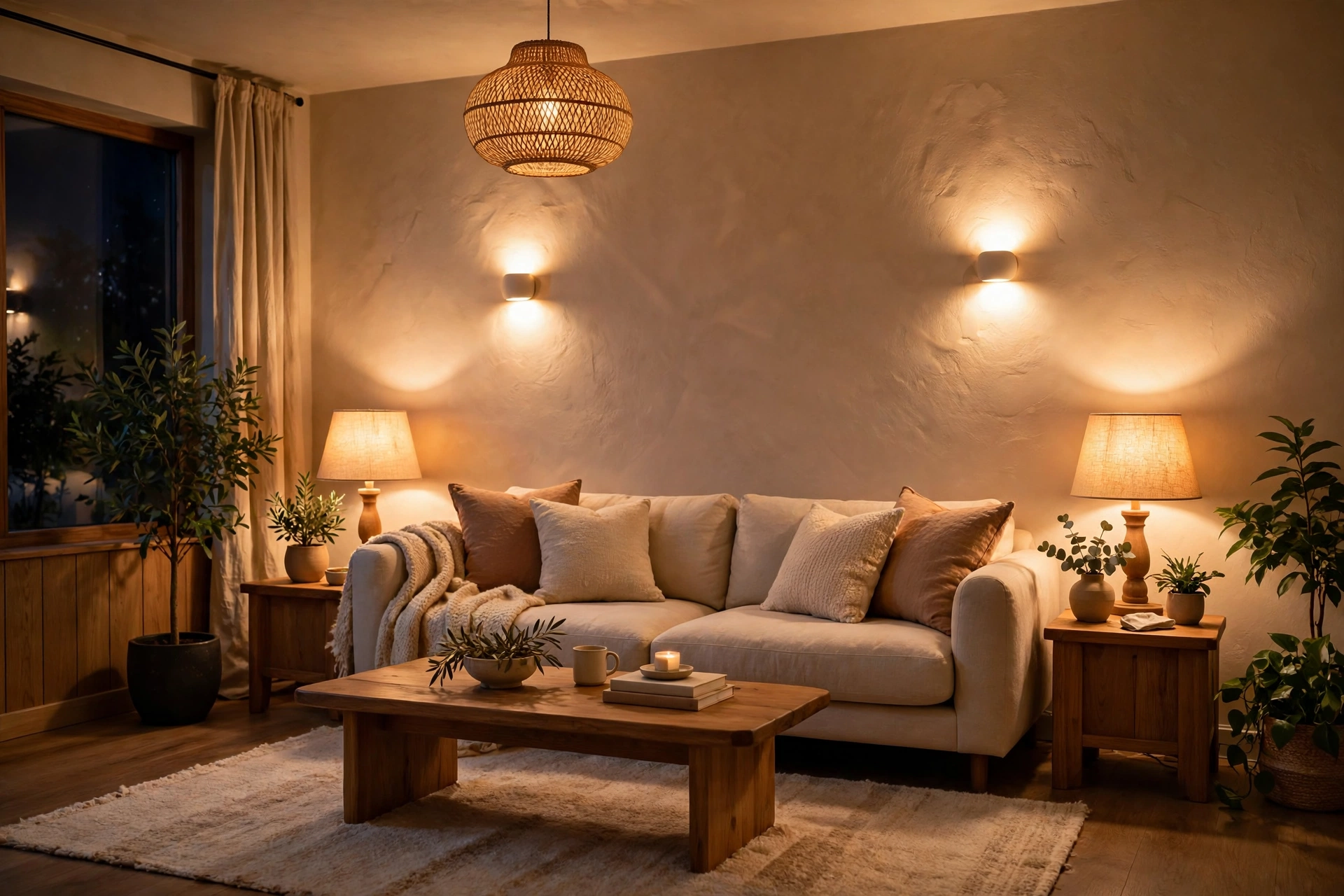
A living room rarely fails because it has too little light. It fails because it has one kind of light, from one place, doing every job at once. A single bright ceiling fixture makes the middle of the room glare and the corners disappear, it flattens faces, and it leaves nowhere for the eye to rest. The rooms that feel warm and finished at night are not the ones with the most expensive fittings. They are the ones with light at three heights, in three layers, each on its own control: a soft base layer from above, a useful layer at seat level, and a quiet accent layer that picks out the things worth looking at. These living room lighting ideas follow that order, so you can build the plan layer by layer instead of buying one more fixture and hoping it fixes the room.
The starting point is not a catalogue. It is an evening in your own room. Notice where people sit, where they read, where the television is, and where the room goes dark first. A reading chair with no lamp beside it will always feel unfinished, however good the ceiling light is. A picture wall with no light on it will always look flat after dark. Once you know what the room has to do, the fixtures choose themselves, and the room ends up with three to five light sources instead of one bright one, all at the same warm colour, all dimmable, each doing a job the others cannot do.
Start with three layers, not one bright ceiling light
Layered lighting is simply the habit of giving different light sources different jobs. The ambient layer is the general glow that lets you move around the room safely and comfortably. The task layer is the focused light where people read, play a game or work on a laptop. The accent layer is the directional light that picks out art, shelves, a fireplace or a plant, and gives the room depth. A fourth layer, decorative light, is the fixture itself: a chandelier or a statement pendant that looks good even when it is off. Most rooms that feel wrong are missing at least one of the first three, and no single fixture, however bright, can replace them.
Think of the layers as heights as well as jobs. Ambient light usually comes from the ceiling. Task light usually sits at seat level, on a side table or beside a chair. Accent light sits low or high: a picture light above a frame, a strip of light inside a bookcase, a small uplight behind a plant. When light comes from three heights at once, the room stops feeling flat, because the eye reads depth from the way the light falls. When all the light comes from one height, the room reads as a single flat plane, and that is what makes it feel like a waiting room rather than a living room.
The other rule that holds the layers together is consistency of colour. Keep every bulb in the room at the same warm white, in the usual living-room range of warm white, so that the ceiling light, the lamps and the accent lights all agree with each other. A cool white ceiling light over warm lamps looks like two different rooms sharing one space, and it is the single most common reason a layered plan still feels wrong. Choose the colour first, then choose the fixtures, and check the bulb boxes before you buy, because two bulbs that both say warm white can still differ enough to show on the wall.
Ambient light: the base layer that fills the room
Ambient light is the base layer, and its job is modest: fill the room evenly enough that nobody has to squint, and leave the interesting work to the other layers. It can come from a central ceiling fixture, from recessed lights, from a torchiere floor lamp bouncing light off the ceiling, or from a combination of all three. What matters is that it is soft and even, without a hard pool of brightness in the middle and dark corners at the edges. A central fixture with a diffuser, or several small recessed lights spread across the ceiling, will do this better than one bare bulb ever will.
How much ambient light a room needs depends on its size, and the honest answer is that there is no single number that fits every room. As a rough planning guide, designers often work with around ten to twenty lumens per square foot for general living-room light, which means a room of about two hundred square feet is aiming for roughly two to four thousand lumens across all its sources combined, not from one fixture. Treat that as a starting point for comparing fixtures, not as a rule to obey, because wall colour, ceiling height and the amount of daylight all change what a room needs. A room with pale walls needs less light than a room with dark ones, which is one reason the colour of the walls and the lighting plan belong together, and our best living room paint colors guide picks shades that stay calm under lamplight as well as in daylight.
Task light: lamps where people actually sit and read
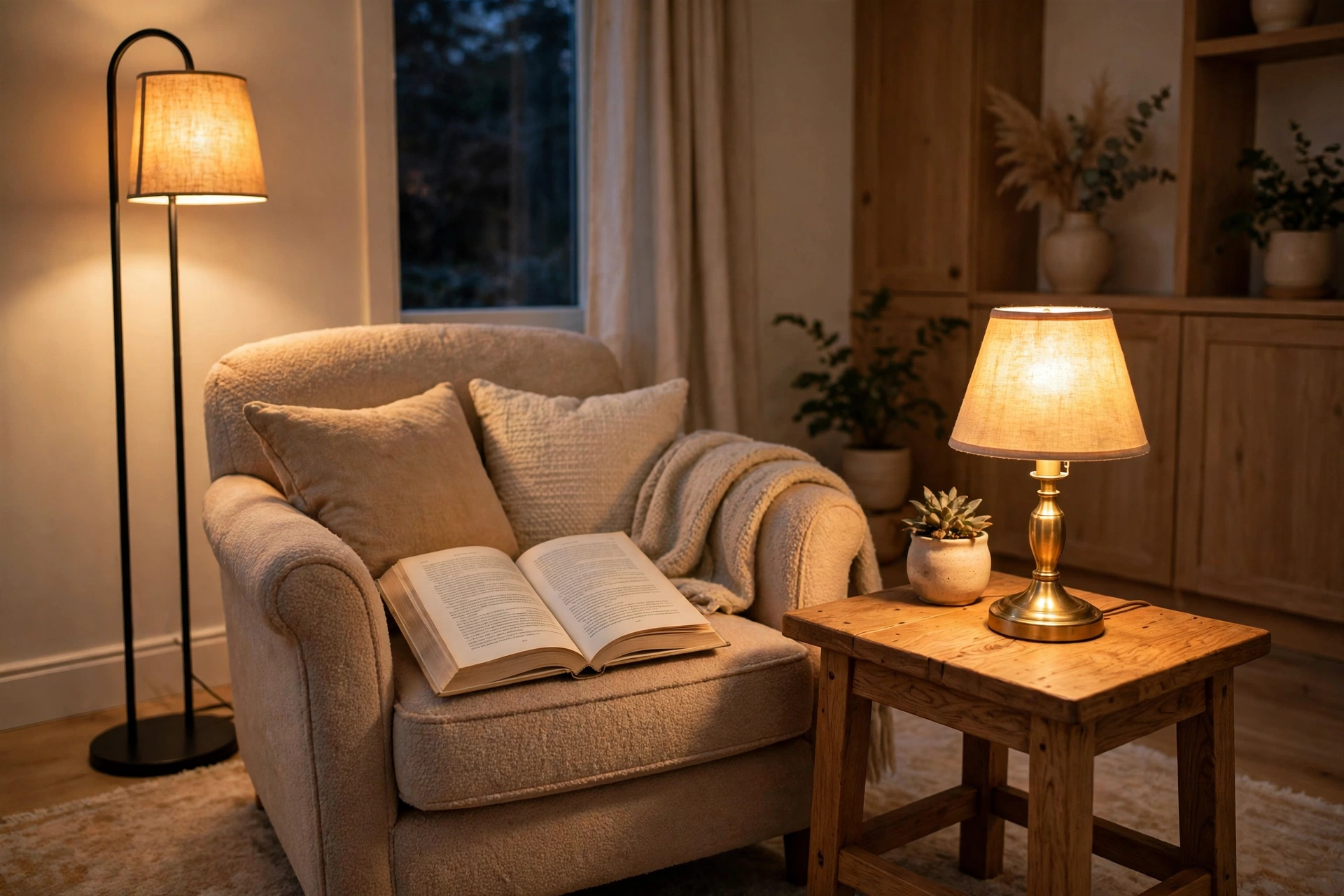
Task light is the layer most living rooms are missing, and it is the easiest to add. It is a floor lamp beside the reading chair, a table lamp on the end table next to the sofa, a swing-arm sconce beside the bed in a room that doubles as a reading corner. Its job is to put useful light exactly where an activity happens, without lighting the whole room to the same level. A reading lamp should throw its light down onto the page or the hands, from beside or slightly behind the reader, never from directly in front of the face, where it shines into the eyes.
Height matters more than brightness here. A floor lamp that stands a little taller than the seated reader’s shoulder, with its shade at about eye level when seated, will light a book without lighting the whole room. A table lamp on a side table should be roughly the same height: tall enough that the bulb is hidden by the shade from across the room, short enough that the light still reaches the seat. If the shade is too high, the bulb glares; if it is too low, the light pools on the table and never reaches the chair. The test is simple: sit in the chair, open a book, and see whether you can read comfortably without squinting and without seeing the bulb.
Task lamps also do the quiet work of making a room feel inhabited. Two table lamps flanking a sofa, both on, make the seating group feel like the centre of the room, even when nobody is sitting there. One floor lamp beside an armchair turns an empty corner into a reading spot, which is often all a bare corner needs. This is also the layer that lets you leave the ceiling light off in the evening, which is when a living room starts to feel like a home instead of a hall. If you buy only one thing after reading this guide, buy the lamp that belongs beside the seat you use most.
Accent light: the layer that gives the room depth
Accent light is the layer that makes a room look designed rather than merely lit. It is a picture light over a framed print, two sconces flanking a fireplace, a small spotlight washing a bookshelf, a strip of light inside a glass cabinet, an uplight behind a large plant. Its job is not to light the room but to direct the eye, and because it is directional, a little of it goes a long way. One or two accent moves are usually enough; five will make the room look like a gallery and tire the eye instead of guiding it.
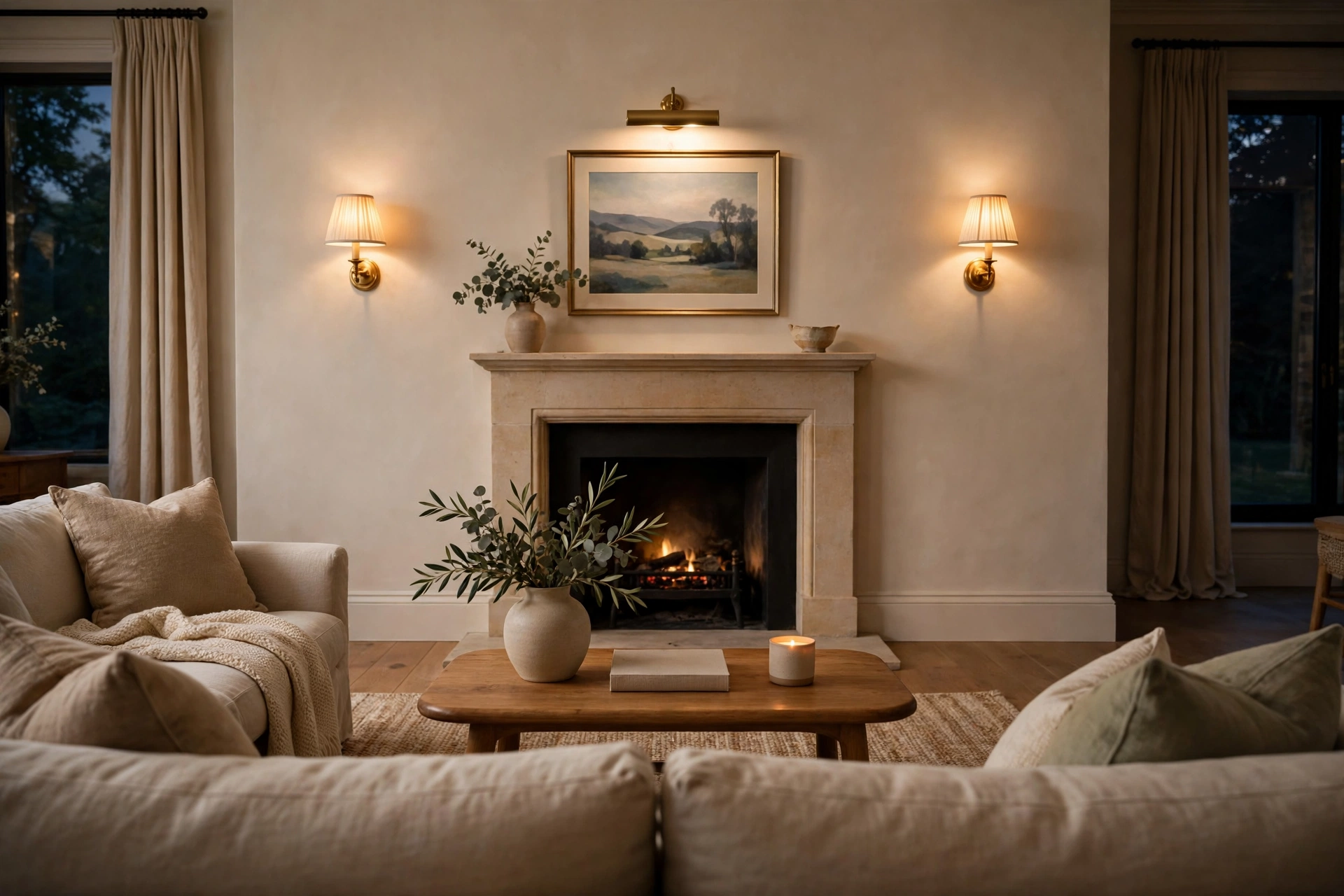
Choose the feature before you choose the fixture. The best accent targets are the things the room is already proud of: the fireplace, the largest piece of art, a built-in shelf, a textured wall, a plant with a good shape. Light those, and leave the plain walls alone. A picture light should sit above the frame and wash down across it evenly, without a bright spot in the middle and dark edges. A shelf light should sit inside the shelf, hidden from view, so you see the books and not the strip. A fireplace looks best with light on either side of it, at picture height, so the fire itself stays the brightest thing in the room.
Warm light and dimmers: the two choices that change everything
If the whole guide had to shrink to two decisions, they would be these: keep the light warm, and put every layer on a dimmer. Warm white, in the usual living-room range, is the colour of lamplight and late sun, and it makes wood look richer, skin look kinder, and fabric look softer. Cool white belongs in a kitchen or a workshop, where you need to see clearly; in a living room it makes the same furniture look grey and the same walls look cold. Check the colour temperature on the bulb box before you buy, and keep every bulb in the room in the same range, so the ceiling, the lamps and the accents all agree.
Dimmers matter because a living room has more than one mood, and a fixed light has only one. The same room needs to be bright for cleaning and homework, medium for conversation and entertaining, and low for a film or a quiet evening. Without dimmers, you get one of those moods and the others have to make do. With dimmers on each layer separately, one room becomes several: ambient high and task low for tidying up, ambient low and task high for reading, everything low and accent on for a film. The cost of a dimmer is small next to the cost of a fixture, and it is the single upgrade that changes how a room feels every single evening.
Keep the dimmers separate, one per layer, rather than wiring everything to a single switch. A single switch forces all three layers to rise and fall together, which defeats the point of having layers at all. Separate controls let you set a scene: reading is ambient low, task high, accent low; entertaining is ambient medium, task medium, accent on; a film is ambient almost off, task off, accent barely on. Learn those three settings for your own room, and the lighting will stop being something you think about and start being something the room simply does.
The ceiling: chandeliers, pendants and recessed light done right
The ceiling fixture is the most visible light in the room, so it has to earn its place twice: as a light and as an object. A chandelier or a large pendant suits a room with a high ceiling and a clear centre, usually above the coffee table, where it can hang low enough to be seen and high enough to walk under. A semi-flush fixture, which sits close to the ceiling, suits a lower ceiling, where a hanging fixture would crowd the room. A flush mount suits the lowest ceilings and the smallest rooms, where anything hanging down would feel in the way. The rule is proportion: the fixture should look like it belongs to the room, not like it was chosen for a different, larger one.
Recessed lights need the same care, because they are easy to get wrong in the opposite direction. Too few of them, and the room has bright pools under each light and dark patches between them. Too many, and the ceiling looks like an airport runway. Spread them evenly, keep them a little way in from the walls rather than tight against them, and put them on a dimmer, because recessed lights at full power are the brightest, hardest light a living room can have. A row of recessed lights washing a wall is often better than a grid covering the whole ceiling, because a lit wall makes the room feel larger, while a lit ceiling makes it feel lower.
When the ceiling fixture is also a statement piece, let it be the one strong object in the room and keep the rest of the lighting quiet. A large pendant over the coffee table, with plain table lamps and a simple picture light, reads as confident. A large pendant plus ornate sconces plus a glittering chandelier reads as a showroom. If you are choosing a ceiling fixture for a room with a clear style, the style of the room should lead: a farmhouse room takes a simple metal or wood pendant better than a crystal chandelier, and our modern farmhouse living room ideas show how one honest fixture, rather than several decorative ones, carries that look. And if the fixture itself is the question, rather than the layout, our guide to choosing the right ceiling light for every room covers size, height and placement room by room.
Floor and table lamps: the easiest layer to add
Lamps are the most forgiving part of a lighting plan, because they need no wiring, no electrician and no commitment. A floor lamp can move from the reading chair to the sofa in a minute, and a table lamp can move from the side table to the console when the room is rearranged. That is why they are the best place to start if the room currently has only a ceiling light: two lamps, one floor and one table, will change the room more than a new ceiling fixture will, and they will do it for less money and less disruption.
Choose lamp shades the way you choose the light, not just the look. A shade that is opaque throws its light up and down, which suits a floor lamp beside a chair, where you want light on the page and a soft glow on the ceiling. A shade that is translucent, in linen or pale fabric, throws light sideways as well, which suits a table lamp on a console, where you want the lamp itself to glow. A dark shade looks dramatic when it is off and drinks light when it is on, so it belongs in a room that already has plenty of light from elsewhere. The shade should hide the bulb from every seat in the room; if you can see the bulb from the sofa, the shade is too short or the lamp is too tall.
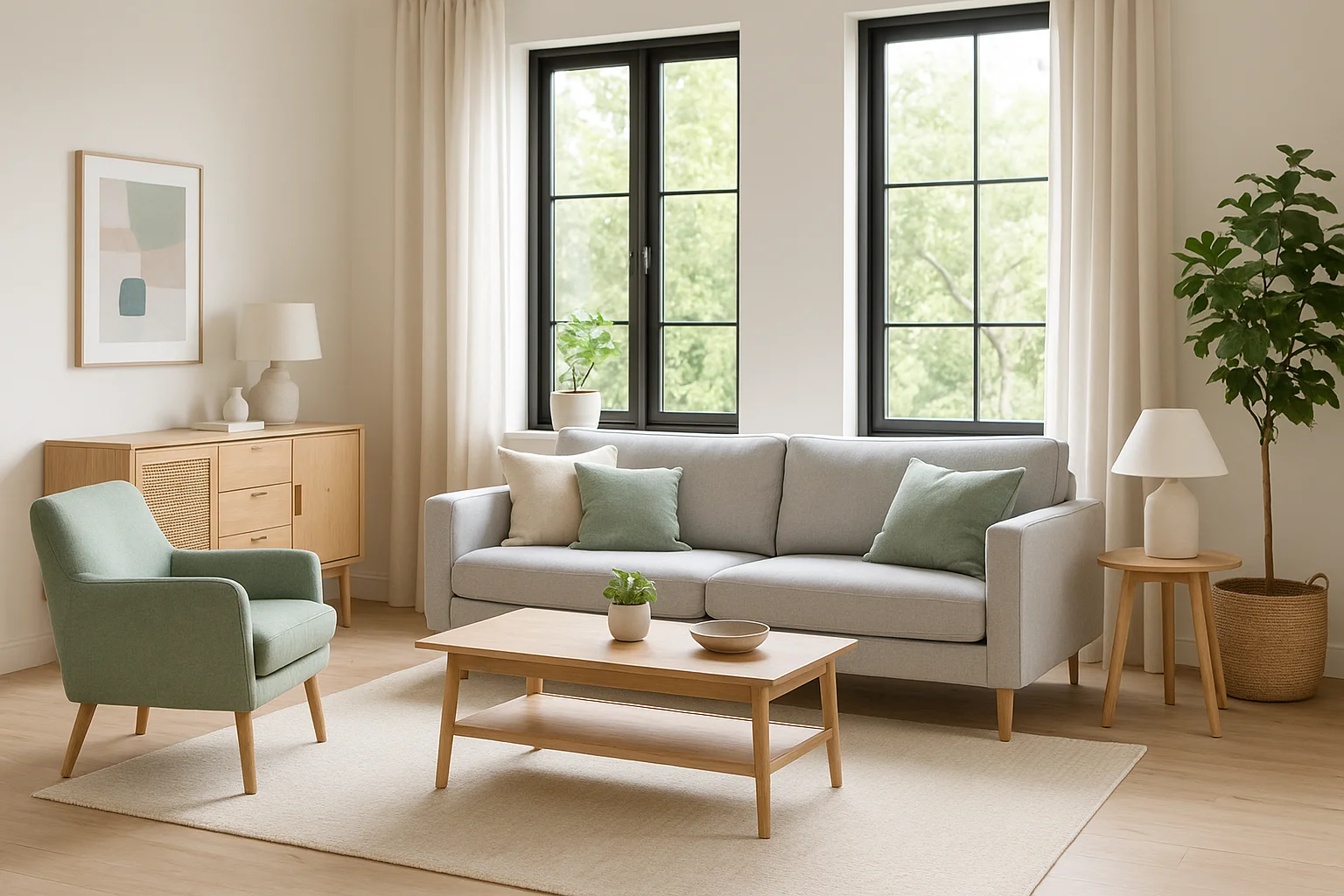
Place lamps where people sit, not where the furniture leaves a gap. A lamp on a console across the room from the sofa is decoration; a lamp on the end table beside the sofa is task light. A floor lamp behind the reading chair lights the wall; a floor lamp beside it lights the book. The test, again, is to sit down and use the room: if the light falls where your hands are, the lamp is in the right place. And keep the lamp in proportion to the furniture beside it: a tall, thin floor lamp suits a slim armchair, a short, wide table lamp suits a low sofa, and a lamp that dwarfs its table will look wrong however good its light is.
Wall light: sconces, picture lights and washing a wall
Wall light is the layer that makes a room feel finished, because it lights the surfaces the ceiling light forgets. A pair of sconces flanking a fireplace, a picture light over the largest piece of art, a row of small lights washing a bookshelf wall: all of these put light on vertical surfaces, which is what the eye actually looks at. A room lit only from above has bright floors and dark walls, and it feels like a basement even on the ground floor. A room with lit walls feels larger, because the eye reads the walls as further away when they are lit, and it feels warmer, because the light is at eye level rather than above it.
Sconces work best in pairs, at about the height of a picture frame, and they work best when they are dimmable, because a sconce at full power is a glare source and a sconce at half power is a glow. Put them where the room has a feature to frame: either side of the fireplace, either side of a large mirror, either side of the sofa if the wall behind it is bare. Avoid putting a single sconce alone on a long wall, where it looks like a mistake, and avoid putting sconces where people will walk past them at head height, where they become a hazard instead of a feature.
Picture lights deserve a note of their own, because they are small, cheap and often the difference between art that looks loved and art that looks hung. A picture light should be about half the width of the frame, mounted just above it, and aimed so the light washes evenly down the picture without a hot spot in the middle. Battery picture lights now do this without wiring, which makes them the easiest accent light to add to a room that is already finished. In a pale, quiet room, where the walls are doing a lot of the work, wall light matters even more, because pale walls show every shadow; the same pale surfaces and honest materials that shape our Scandinavian living room ideas need warm wall light in the evening, or the room that looks bright by day can feel cold after dark.
Small living rooms and open-plan rooms: light without clutter
A small living room does not need fewer lights, it needs smaller ones. A large chandelier in a small room crowds the ceiling and makes the room feel lower, while three small sources, a semi-flush ceiling light, one table lamp and one picture light, will light the same room without taking up any floor space at all. Wall lights are the small room’s best friend, because they add a whole layer of light without using a single inch of floor or table. A small room lit at three heights, ceiling, wall and table, will feel larger than the same room lit by one bright ceiling fixture, because the lit walls push the edges of the room further away.
Keep the fixtures in scale with the room. A floor lamp with a wide base and a large shade will eat a corner that a small room cannot spare; a slim torchiere, which bounces its light off the ceiling, will light the same corner from a footprint no bigger than a dinner plate. A table lamp on a narrow side table should be slim as well, and the shade should be narrower than the table, so the lamp reads as part of the table rather than as a second piece of furniture. The same thinking that keeps a small room uncluttered applies to its light, and our small living room design ideas show how a simple layout and a restrained palette leave room for the light to do its work.
Open-plan rooms have the opposite problem: too much space, and one lighting plan trying to cover a living area, a dining area and sometimes a kitchen as well. The answer is to light each area as its own room, with its own layers and its own controls. The living area gets its ceiling light, its reading lamp and its accent light; the dining area gets a pendant over the table, on its own dimmer; the kitchen keeps its own task light. A rug under the seating group helps the eye read where one area ends and the next begins, and the light should follow the same boundary: when the dining pendant is on and the living-room lamps are low, the room reads as a dining room, and when the lamps are up and the pendant is off, it reads as a living room. One switch for the whole open space will never do that.
TV, glare and evening light: getting the night-time room right
The television is the hardest object in a living room to light around, because it is a light source itself, and any bright light behind it or opposite it will fight with the screen. The rule is simple: no light source should be visible in the screen, and no bright light should sit directly behind the television, where it will halo the edges of the picture. A lamp beside the sofa, a dim ambient layer, and a soft light behind the television, such as a low strip of light on the wall or a lamp on the media unit, will let you watch comfortably without sitting in the dark, which is what strains the eyes.
Glare is the other night-time problem, and it comes from seeing a bare bulb from a seat. Walk around the room at night, sit in every seat, and look for bulbs you can see directly: the ceiling fixture from the sofa, the table lamp from the armchair, the sconce from the dining table. Every bulb you can see is a bulb that needs a shade, a diffuser, or a dimmer turned down. Frosted bulbs, fabric shades and dimmers all do the same job, which is to spread the light out so it arrives at the eye softly. A room with no visible bulbs will feel calm even when it is bright, and a room with one bare bulb will feel harsh even when it is dim.
Finally, remember that evening light is judged by the people sitting in it, not by the person who installed it. Sit in the room at the time you actually use it, with the television on and the lamps as you would have them, and ask whether you can see faces clearly, read a page comfortably, and watch the screen without squinting. If one of those fails, the fix is usually a small one: a dimmer turned down, a lamp moved a foot to the left, a shade changed, a bulb swapped for a warmer one.
Frequently Asked Questions
How many light sources should a living room have?
Three to five, as a rule of thumb, spread across the three layers: one ambient source from the ceiling, one or two task lamps at seat level, and one or two accent lights on the features worth showing. Fewer than three usually means a layer is missing, and more than five can make the room feel busy unless each one is dimmed low. The number matters less than the spread: light at three heights, in the same warm colour, each on its own control, will feel right in almost any size of room.
What colour temperature is best for a living room?
Warm white, in the usual living-room range, is the standard choice, because it makes wood, fabric and skin look warmer and the room feel like a place to rest. Cool white suits kitchens and workspaces, where you need to see clearly, but in a living room it makes the same furniture look grey and the walls look cold. Keep every bulb in the room in the same warm range, so the ceiling light, the lamps and the accent lights all agree with each other.
Should living room lights be on dimmers?
Yes, wherever it is practical. A living room needs to be bright for cleaning, medium for conversation and low for a film, and a fixed light can only give you one of those. Put each layer on its own dimmer, so the ambient, task and accent layers can be set independently, and learn the three settings your room uses most: bright for tidying, medium for entertaining, low for the evening.
How do I light a small living room?
Use smaller fixtures and lean on the walls. A semi-flush ceiling light, one slim table lamp and a picture light or a pair of sconces will light a small room at three heights without taking up floor space. Avoid a large chandelier, which crowds a low ceiling, and avoid a single bright ceiling light, which flattens the room. Lit walls make a small room feel larger, because the eye reads a lit wall as further away than a dark one.
Where should I put a floor lamp in the living room?
Beside the seat that gets used most, usually the reading chair or the end of the sofa, with the shade at about eye level when seated, so the light falls on the book or the hands without shining into the eyes. A floor lamp behind the chair lights the wall instead of the reader, and a floor lamp across the room from the seating is decoration rather than task light. If you can read comfortably from the chair without seeing the bulb, the lamp is in the right place.
How do I stop glare on the television?
Keep bright light sources out of the screen’s reflection: no lamp directly opposite the television, no bare bulb visible from the sofa, and no bright light directly behind the set. Use a dim ambient layer, a lamp beside the seating rather than behind it, and a soft light behind the television if the wall behind it goes very dark. If you can see a bulb reflected in the screen from your usual seat, move the lamp or dim it until the reflection disappears.
Pingback: Small Entryway Ideas: Slim Storage, Hooks and Light