A small laundry room is not a failed room. It is a room that was given one job and very little floor, and most of the frustration comes from treating it like a small kitchen instead of a working corner. The machines do the washing. Everything else in the room — sorting, folding, drying, storing detergent — has to happen in the gaps around them, and in a small room those gaps are the whole design problem. Get the gaps right and a room the size of a closet can carry a full laundry routine without anything spilling into the hallway.
The order that works is simple: decide the machine layout first, then build storage up the walls, then give every job a surface, and only then think about colour and style. A pretty room with the wrong layout stays frustrating, while a plain room with stacked machines, a folding counter and a drying spot that folds away feels easy to use every day. This guide follows that order, from the machines outwards, so each idea earns its place before the next one is added.
Stack the washer and dryer first
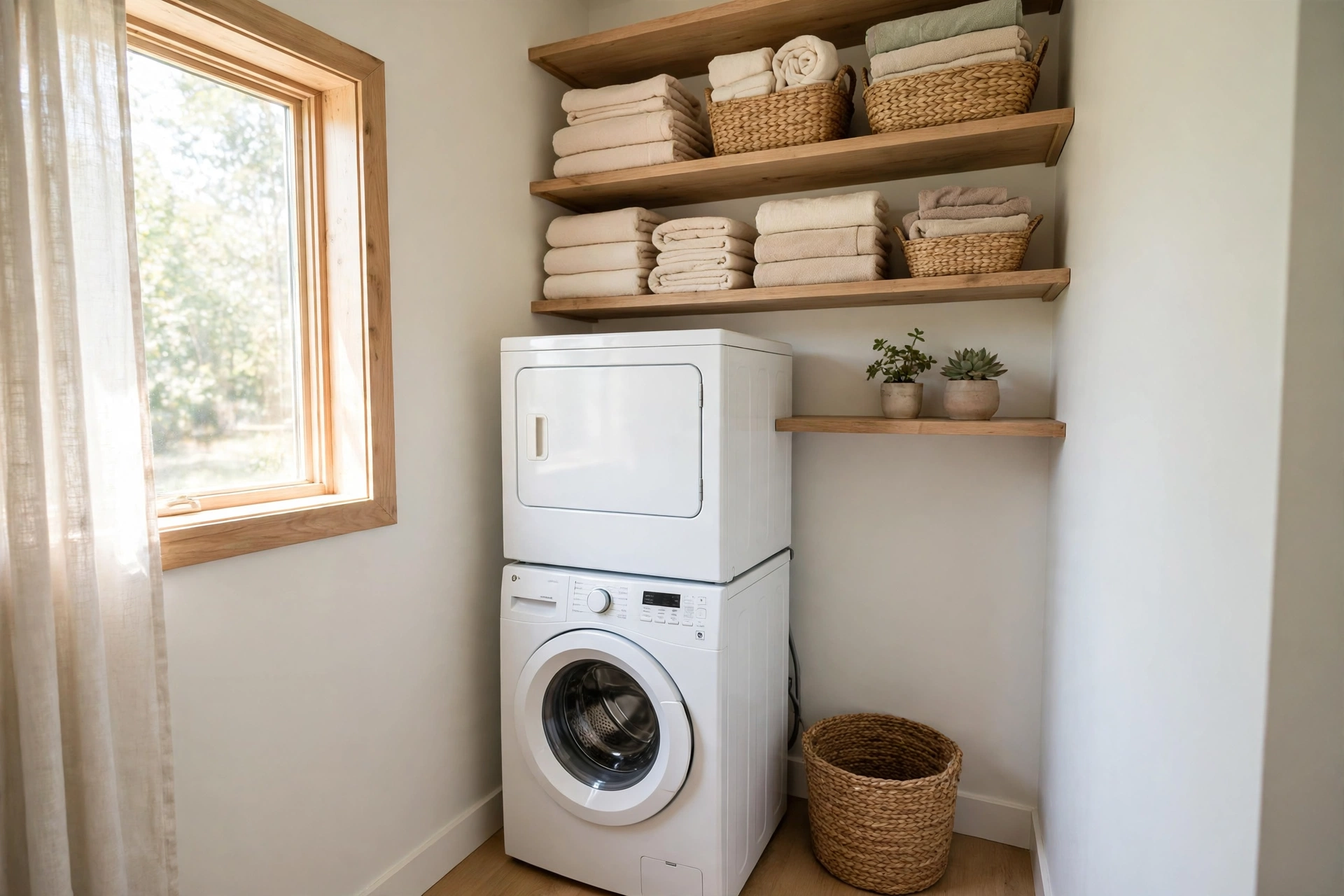
Stacking is the single biggest space saver in a small laundry room, and it should be the first decision, not an afterthought. A dryer sitting on top of the washer frees the full footprint of one machine, which in a tiny room is often the difference between having a folding surface and having nowhere to put a basket down. Most front-load pairs are made to stack with a kit from the same brand, and the controls on modern stacked pairs usually sit at a height that is still easy to reach. Check the ceiling height before you commit — a stacked pair needs room above it for the dryer and for you to load it comfortably — and leave a small gap at the back for the hoses and the vent.
If stacking does not suit the room, a single washer-dryer combo unit is the other way to halve the footprint. One machine washes and dries, so it takes the space of one machine instead of two, though the loads are smaller and the drying cycle runs longer than a separate dryer. For a one- or two-person household that trade is usually worth it. For a family doing several loads a day, a stacked pair is the better answer, because the washer can start the next load while the dryer is still running.
Whichever you choose, measure the width, depth and height of the room first, including the door swing. A machine that fits the wall but blocks the door from opening fully will annoy you every single day, and a door that swings the other way is often a cheaper fix than a smaller machine. Keep at least a hand’s width of clearance on the sides so the machines can vibrate without knocking against the wall or each other.
Build storage up the walls, not out into the room
When the floor is full, the walls are the only space left, and in a laundry room the wall above the machines is usually empty. Two floating shelves or a shallow wall cabinet above the machines holds detergent, stain spray and dryer sheets exactly where they are used, without taking a single inch of floor. Keep the lowest shelf high enough that it clears the top of the machines with room to load them, and keep everyday items on the lowest shelf and spares up high.
A peg rail or a row of hooks on the free wall does the same work for things that hang — the ironing board, a dustpan, a bag of pegs. Hooks take almost no depth, so they suit the narrowest rooms, and they keep awkward items off the folding counter where they would otherwise live permanently. A tall, slim cabinet in a corner can hold the vacuum, the mop and the bulk supplies that do not fit on the shelves, and because it is tall rather than wide it asks very little of the floor.
Open shelves suit the things you reach for every day, because you can see them and grab them without opening a door in a tight space. Closed cabinets suit the things you would rather not look at — cleaning chemicals, spare sponges, the iron. A mix of the two is usually right: open where your hands go daily, closed where the clutter lives. The same build-up habit runs through our small apartment design ideas, where the wall above a desk or a bed does the same job of holding what the floor cannot.
Give folding a real surface
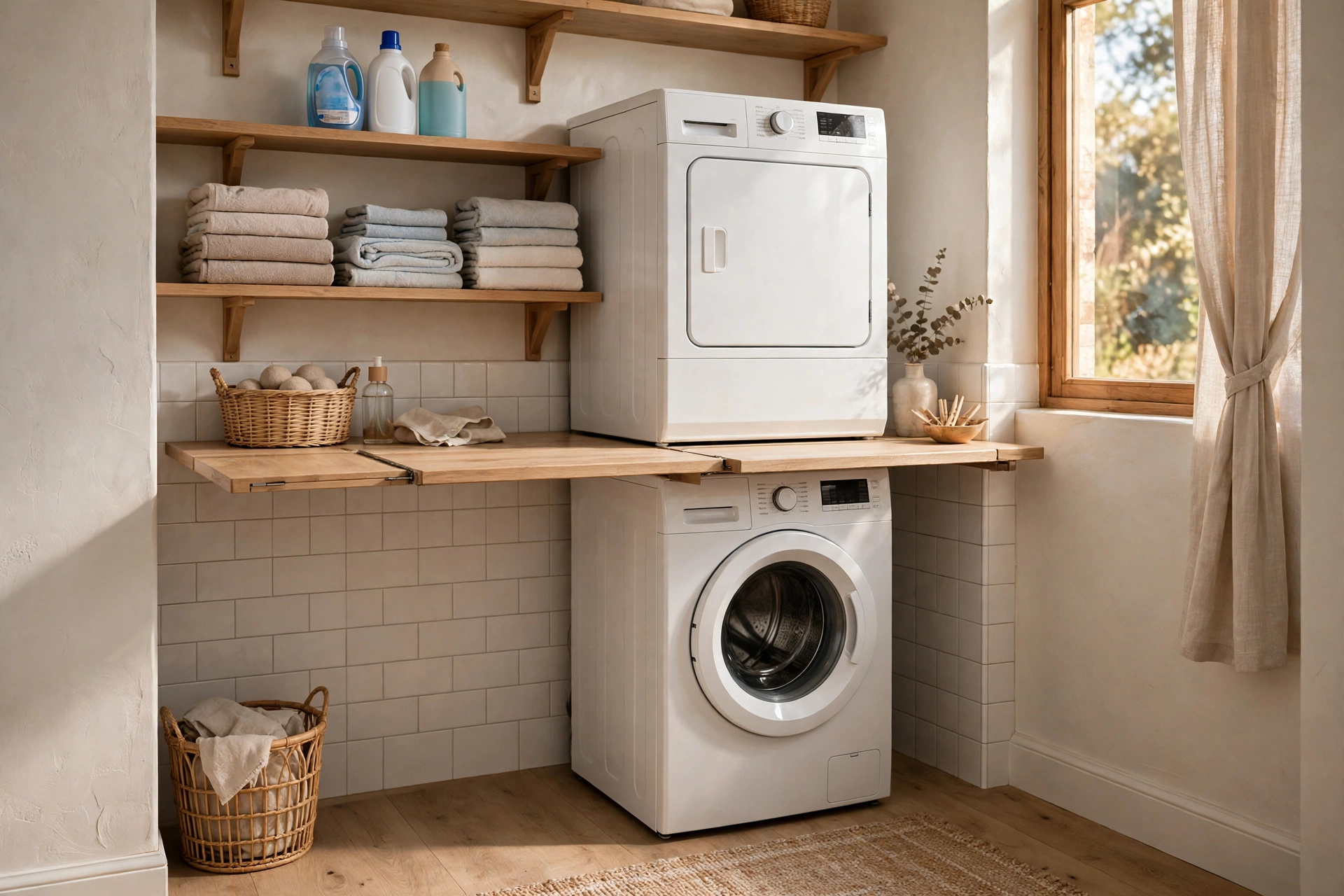
Folding laundry without a surface means folding it on the bed, on the sofa, or on top of the machines while they vibrate — and that is why clean laundry ends up in a pile that never gets put away. A countertop laid across two front-load machines gives you a folding surface at waist height for the price of a single board, and it doubles as the place where the basket lands when a load finishes. A simple piece of wood, sanded and sealed, is enough; it does not need to be stone or a matching worktop to do the job well.
If the machines are stacked, the counter has to go elsewhere. A wall-mounted fold-down shelf is the answer in that case: it folds up against the wall when you do not need it and drops down to a proper surface when a load finishes. Fit it at waist height on the wall opposite the machines, or beside them if the wall is free, and make sure it can hold the weight of a full basket without sagging. A slim rolling cart that slides into the gap beside the machines is the other option — it holds detergent and small items on tiered shelves and pulls out to become a narrow worktop when you need one.
Whatever surface you choose, protect it. Keep only the current load on it, and put the basket away the moment the folding is done. A folding counter that becomes permanent storage for clean clothes stops being a work surface, and the next load has nowhere to go. The habit matters more than the material: clear surface, one load, fold, put away.
Turn a closet into a laundry room
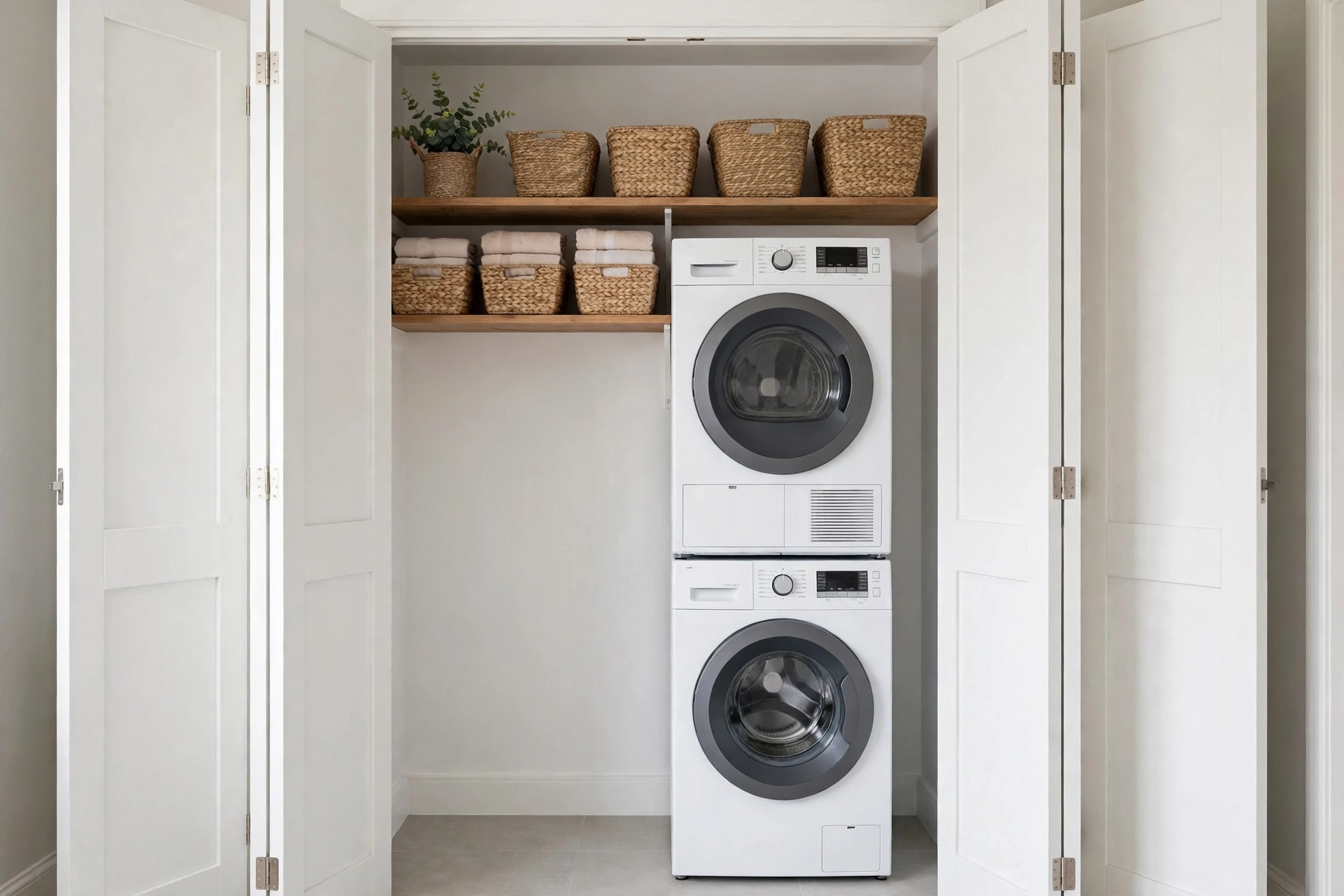
When there is no laundry room at all, a closet is often the best one you can make. A standard hall or bedroom closet is usually wide enough for a stacked pair, and with bi-fold or pocket doors it needs no floor space for the doors to swing. The machines go in, shelves go above them, and the doors close on the whole thing when the washing is done. For an apartment, this is often the only realistic laundry room, and it works well because everything is contained in one cupboard.
A closet conversion needs three things that are easy to forget: water and drainage for the machines, ventilation so damp air has somewhere to go, and light inside the closet so you can see what you are doing. A small light fitted inside the top of the closet changes the space completely, and a louvred or vented door lets air move without leaving the machines on show. If the closet is near a bathroom, the plumbing is usually close at hand, which is why so many laundry closets sit beside or inside a bathroom wall. The practical side of fitting a small room around water and drains is covered in our small bathroom design ideas, where the same tight-space plumbing thinking applies.
Inside the closet, keep the layout simple: machines at the bottom, one shelf above them for detergent, and baskets on the shelf for sorting. Do not try to fit a folding surface inside a closet that is only just wide enough for the machines — fold the washing elsewhere, at a table or a counter, and treat the closet as the washing station only. A closet that tries to do everything ends up doing none of it well.
Solve drying without a floor rack in the way
Wet clothes are the enemy of a small room. They take up space, they make the air damp, and a floor drying rack left open in the middle of the room turns the whole space into an obstacle course. The fix is to dry upwards or to dry out of the way. A wall-mounted accordion rack folds flat against the wall when it is not in use and opens out to hold a full load when it is. Fit it on the wall above the folding counter or on the free wall, where it does not block the door.
A ceiling-mounted drying rack or a simple tension rod fixed between two walls does the same work with even less wall taken. Hang shirts and delicates on hangers from the rod, and they dry straight, need less ironing, and take up air rather than floor. In a room with a window, the rod near the window dries clothes fastest, and the light makes the room feel less like a cupboard. If the room has no window, an extractor fan or a small dehumidifier matters more than any rack, because damp air with nowhere to go will leave the room smelling stale no matter how tidy it is.
Keep one rule for drying: only what is actually wet hangs in the room. Dry clothes come down the moment they are dry, and the rack folds away. A rack that stays up permanently becomes a second wardrobe that nobody asked for, and the room loses the clear wall it needs for everything else.
Hide the mess behind doors, baskets and curtains
A small laundry room looks messy faster than any other room, because everything in it is in use — baskets, bottles, half-folded piles — and there is nowhere for any of it to hide. The answer is not more cleaning, it is more hiding. Doors on the machines, a curtain across open shelves, and baskets that match each other turn a working room into a calm one without removing a single useful thing. A bi-fold door on a laundry closet does this for the whole room at once: close it and the laundry disappears.
Baskets are the simplest hiding place, and they work best when they match. Three or four baskets in the same material — woven, canvas, or plain plastic in one colour — read as storage, while four different baskets read as clutter, even when they hold exactly the same things. Give each basket one job: one for sorting, one for clean laundry waiting to be folded, one for ironing. Label them if the household shares the room, so a basket does not become a mystery pile that nobody owns.
Keep the counter clear and the floor clear, and the room will feel twice its size even when the shelves are full. The floor is the part of the room your eye reads first, so a clear floor with one basket on it looks tidier than a full floor with tidy shelves. Put the laundry basket on a shelf or in a pull-out drawer under the counter if you can, and keep only the basket for the current load on the floor. The same hide-the-working-parts thinking shapes the calm, uncluttered rooms in our Scandinavian living room ideas, where pale surfaces and closed storage do the quiet work of making a room feel larger than it is.
Light and colour: keep it bright, keep it simple
Small laundry rooms are often windowless or lit by a single bare bulb, which makes them feel like cupboards whatever you put in them. Light is the cheapest improvement you can make. A bright ceiling light that actually fills the room, a small light inside a closet, and under-shelf lighting above the folding counter together change the room more than any new machine. Warm white bulbs suit a laundry room better than cold ones, because cold light makes white walls look grey and tired, while warm light makes the same walls look clean.
For colour, pale is the safe choice in a room this small: white, warm off-white or a very pale sage on the walls, with one stronger colour used in small doses — a patterned floor, a bright basket, a painted door. A bold colour on every wall in a tiny windowless room can feel heavy, while one bold touch gives the room character without closing it in. If the room has a window, the colour choice matters less, because daylight does the work of keeping it bright.
Paint the inside of a laundry closet a light colour even if the rest of the house is darker, because a dark closet is a closet you cannot see into. A pale interior, a light inside the top, and a mirror on the inside of the door together make a closet laundry feel like a room rather than a cupboard. Pale, warm neutrals are the safest choice in a small utility space for the same reason they work in larger rooms: they bounce what little light there is instead of absorbing it.
Share the room with a kitchen or bathroom
Many small homes have no separate laundry room, so the machines share a kitchen or a bathroom. Sharing works when the machines have their own zone and their own storage, and fails when they are squeezed into whatever gap is left. In a kitchen, the best place is usually under a stretch of counter, with the machines behind a cupboard door that matches the kitchen units, so the kitchen reads as a kitchen and the laundry disappears when it is not running. A slim pull-out beside the machines holds detergent, and the kitchen counter becomes the folding surface.
In a bathroom, the machines usually go under a counter beside the basin or in a tall cupboard, and the bathroom’s own storage has to give way a little. Keep laundry supplies in one basket or one shelf, not spread across the bathroom’s shelves, so the bathroom does not slowly turn into a laundry room with a bath in it. A laundry-bathroom combination works best in a household where the washing is done in a few set loads a week, rather than a load a day, because the room has to change back into a bathroom between loads. Fitting machines around existing plumbing and tight corners is familiar ground — our small kitchen design ideas shows the same thinking applied to fitting more work into a small kitchen footprint.
Whichever room you share, keep the machines’ noise in mind. A washer on a spin cycle in a kitchen is louder than the same machine behind a closed laundry-room door, so a machine with a quiet spin and a door that closes between the machines and the living space is worth choosing when the laundry shares a room people sit in.
Three layouts that work in almost any small room
Most small laundry rooms fall into one of three shapes, and each has a layout that suits it. The single-wall layout puts everything on one wall — machines side by side or stacked, shelves above, folding counter across the front — and leaves the rest of the room clear. It suits a narrow room or a hallway corner, and it is the simplest to build because all the plumbing sits on one wall. The galley layout puts the machines on one wall and a narrow counter on the opposite wall, with a small aisle between them. It suits a slightly wider room, and the opposite counter becomes the folding surface, so nothing has to fold on top of the machines.
The closet layout is the third, and it is really a single-wall layout with doors on it. Everything sits inside the closet, and the room outside the closet stays a hallway or a bedroom. It suits homes with no spare room at all, and it asks the least of the house, because the laundry takes no floor from any living space. Choose the layout by the room you have, not by the one you wish you had: measure the width first, and the layout usually chooses itself. A room less than a metre and a half wide is a single wall or a closet; a room wider than that can take a galley.
Before you build anything, mark the layout on the floor with tape. Walk through a full load — carry the basket in, load the washer, move the load to the dryer, fold it — and see where you bump into things. Tape is free, and moving a shelf after it is fitted is not. Ten minutes with tape saves the most common mistake in a small laundry room: a folding counter that blocks the door, or a drying rack that hangs over the machines where you need to load them.
Style it last, and keep it practical
Style is the last job, not the first, and in a laundry room it should be the lightest touch. One patterned element — a tiled floor, a wallpapered back wall, a row of matching baskets — gives the room its character, and everything else stays plain and washable. A laundry room gets wet, dusty and knocked about, so the finishes have to survive that: wipeable paint, a floor that does not mind water, shelves that can be wiped down. Pretty finishes that cannot be cleaned will look tired within a year, however good they looked on the first day.
Pick a style direction and keep it consistent with the rest of the house, so the laundry room feels like part of the home rather than a service cupboard that was decorated by accident. A farmhouse laundry with wood and woven baskets suits a house that already leans that way; a pale, minimal laundry suits a house that leans modern. Our interior design styles guide lays out the main directions, and the one that matches your home is the right one for the laundry room too — the room is small, so even a small nod to the house style is enough to tie it in.
Finally, leave one thing in the room that is purely for pleasure: a small plant that likes humidity, a framed print, a nice soap dispenser instead of the bottle it came in. A laundry room that has one pleasant thing in it is a room you do not mind walking into, and that is the difference between a chore corner and a room that works. Keep it to one thing, though — two or three decorative objects in a tiny room are clutter, and clutter is what the whole guide has been removing.
Frequently Asked Questions
What is the best layout for a very small laundry room?
Stack the washer and dryer on one wall, put shelves above them, and add a folding surface either across front-load machines or as a fold-down shelf on the opposite wall. That single-wall layout uses the least floor and leaves the rest of the room clear, and it suits almost any room that is too narrow for anything else.
Can a washer and dryer go in a closet?
Yes, if the closet is wide enough for the machines and has water, drainage, ventilation and a light inside. A stacked pair fits most standard closets, and bi-fold or pocket doors keep the floor clear. Do not try to fit a folding surface inside the closet as well — fold the washing elsewhere and treat the closet as the washing station only.
How do I dry clothes in a small laundry room without a floor rack?
Use a wall-mounted accordion rack that folds flat when it is not in use, a tension rod between two walls for hangers, or a ceiling-mounted rack. Hang only what is wet, take dry clothes down promptly, and fold the rack away so the wall is clear for other jobs.
Where should I store detergent in a tiny laundry room?
On the lowest shelf above the machines, or in a slim rolling cart beside them, so it is within reach while you load the washer. Keep everyday detergent at hand height and spare bottles on a higher shelf, and keep cleaning chemicals in a closed cabinet rather than on an open shelf.
What colour should I paint a small laundry room?
Pale colours — white, warm off-white or a very pale sage — keep a small, often windowless room bright, with one stronger colour used in small doses, such as a patterned floor or a painted door. Warm white bulbs suit the room better than cold ones, which can make white walls look grey.
How can I keep a small laundry room tidy every day?
Give every job a home — one basket for sorting, one for clean laundry, one for ironing — keep the folding counter clear between loads, and fold the drying rack away when it is empty. A five-minute reset after each load matters more than a weekly deep clean, because a small room shows clutter faster than a large one.