
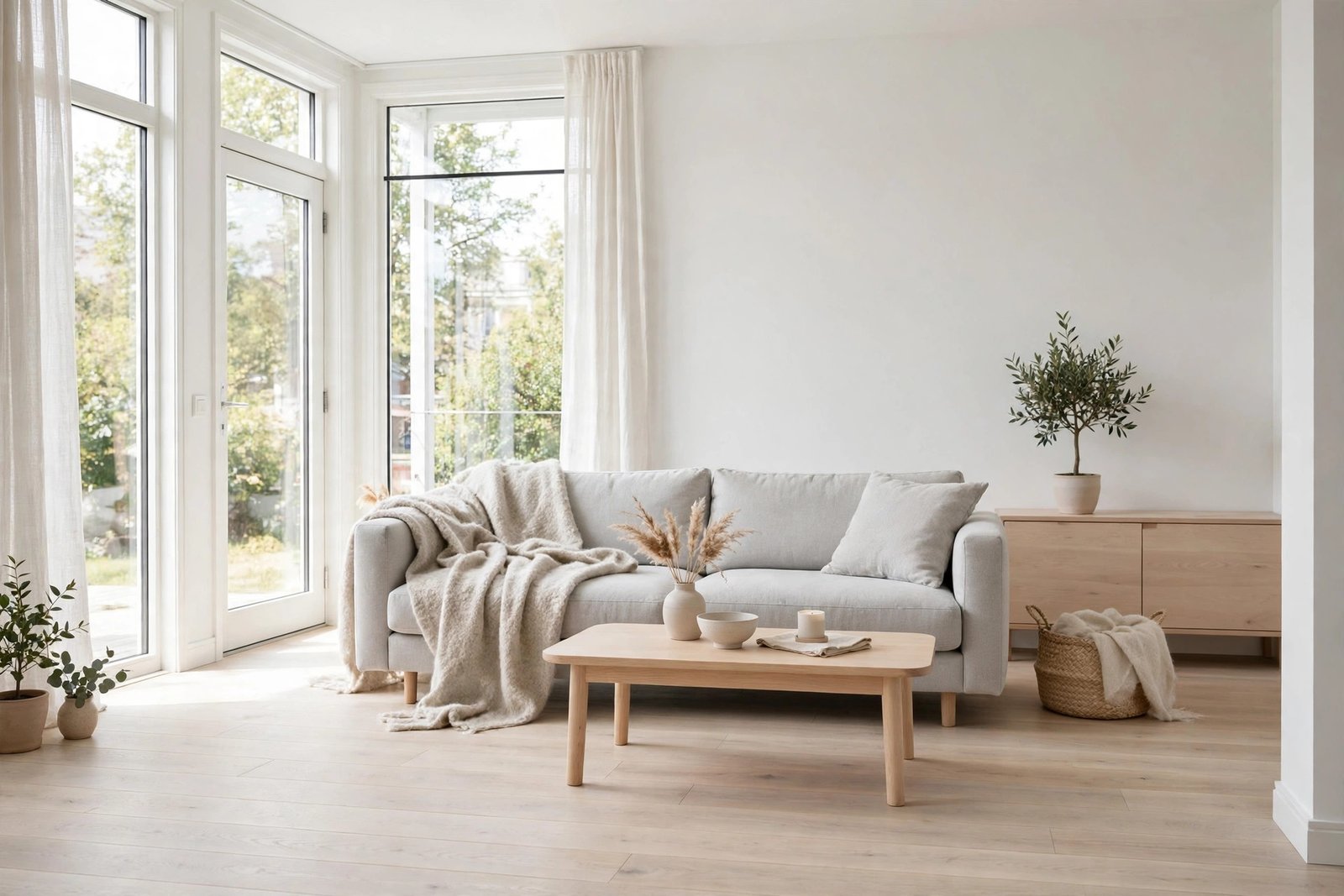
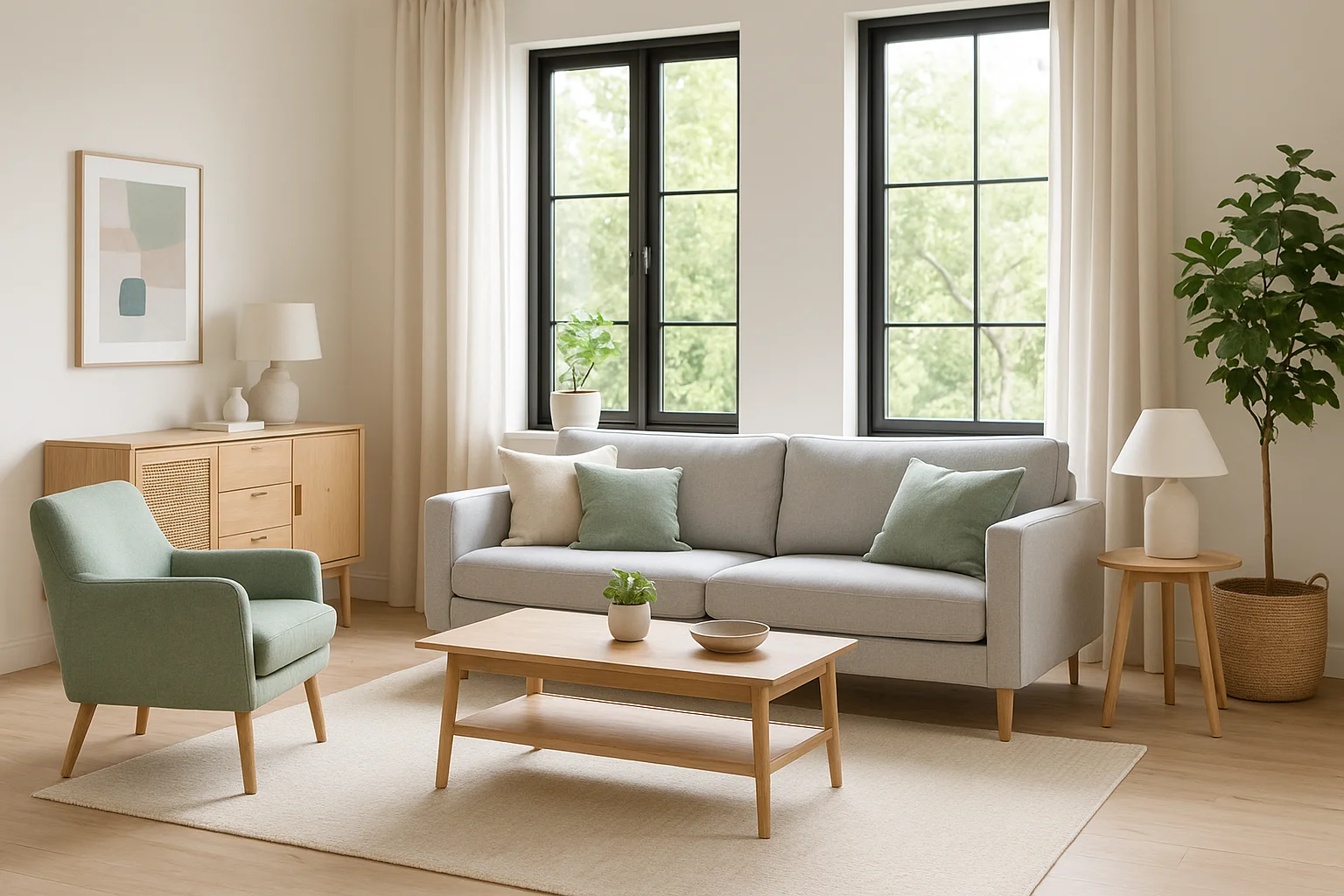
A Scandinavian living room is easy to recognise and hard to copy well. The look is pale, calm and uncluttered, but it is not empty. What makes it work is not the white walls alone — it is the balance underneath them: pale wood against soft textiles, clean furniture shapes against one or two warm details, and daylight treated as the most important feature in the room. Get that balance right and the room feels bright without feeling cold, and simple without feeling bare.
This guide works through the style in the order that matters. Start with light, then the wood, then the furniture shapes, then the textiles, then the one warm accent that keeps the room from feeling like a showroom. The ideas below suit a rented flat or a home you own, and most of them are about what to leave out, not what to buy. Scandinavian design is, above all, a style of restraint — and restraint is free.
Start with the light, not the furniture
Scandinavian design grew out of long, dark winters, so light is the first decision, not an afterthought. In a Scandinavian living room the window is the centrepiece. Keep it clear. Curtains, if you use them at all, should be light, plain and hung high and wide, so the full window shows when they are open. A heavy curtain, a dark blind, or a tall piece of furniture in front of the window works against the whole style, however good it looks on its own.
Choose the wall colour for the light you actually have, not the light in a photograph. A warm white or a very pale warm grey suits most rooms, because it reflects the daylight without going blue in the evening. Pure bright white can look stark in a north-facing room, while a warm white keeps the room soft after dark. Test a patch on the wall that faces the window and live with it for a few days, in daylight and in the evening, before you commit to the whole room.
Keep the ceiling and the window frames the same pale tone as the walls, or as close to it as you can. The fewer visual edges in the room, the larger and calmer it feels — the same thinking behind our small living room design ideas, where one continuous light surface reads as more space. In a Scandinavian room that continuity is the whole point: walls, ceiling and floor should feel like one quiet background, not four separate surfaces competing for attention.
Choose pale wood first
Pale wood is the material that defines the style. Oak, ash and birch in their lightest tones bring warmth into a pale room without adding colour, and they keep the floor, the furniture and the small details feeling like one family. A pale wood floor is the ideal starting point. If the floor is already dark, a large pale rug in a plain tone does much of the same work — it breaks the dark floor and gives the furniture a light base to sit on.
Use the same pale tone across the big pieces. A light oak coffee table, a pale wood television console, and light wood legs on the sofa and chairs read as one decision, even when the pieces were bought years apart. Mixing one pale wood with one dark wood can work, but only as a deliberate contrast — a single dark walnut side table, for example — and only when the rest of the room stays pale. Two or three competing wood tones, with no clear dominant one, make the room look accidental rather than Scandinavian.
Keep the wood honest and simple. The style favours plain, matte finishes and visible grain over gloss, varnish and heavy ornament. A pale oak table with a clean edge and no carved detail is more Scandinavian than an ornate piece in a light stain. If a piece you already own is dark and glossy, a pale linen runner, a light tray, or simply moving it out of the main sightline can soften it without replacing it.
Keep the furniture shapes clean and low
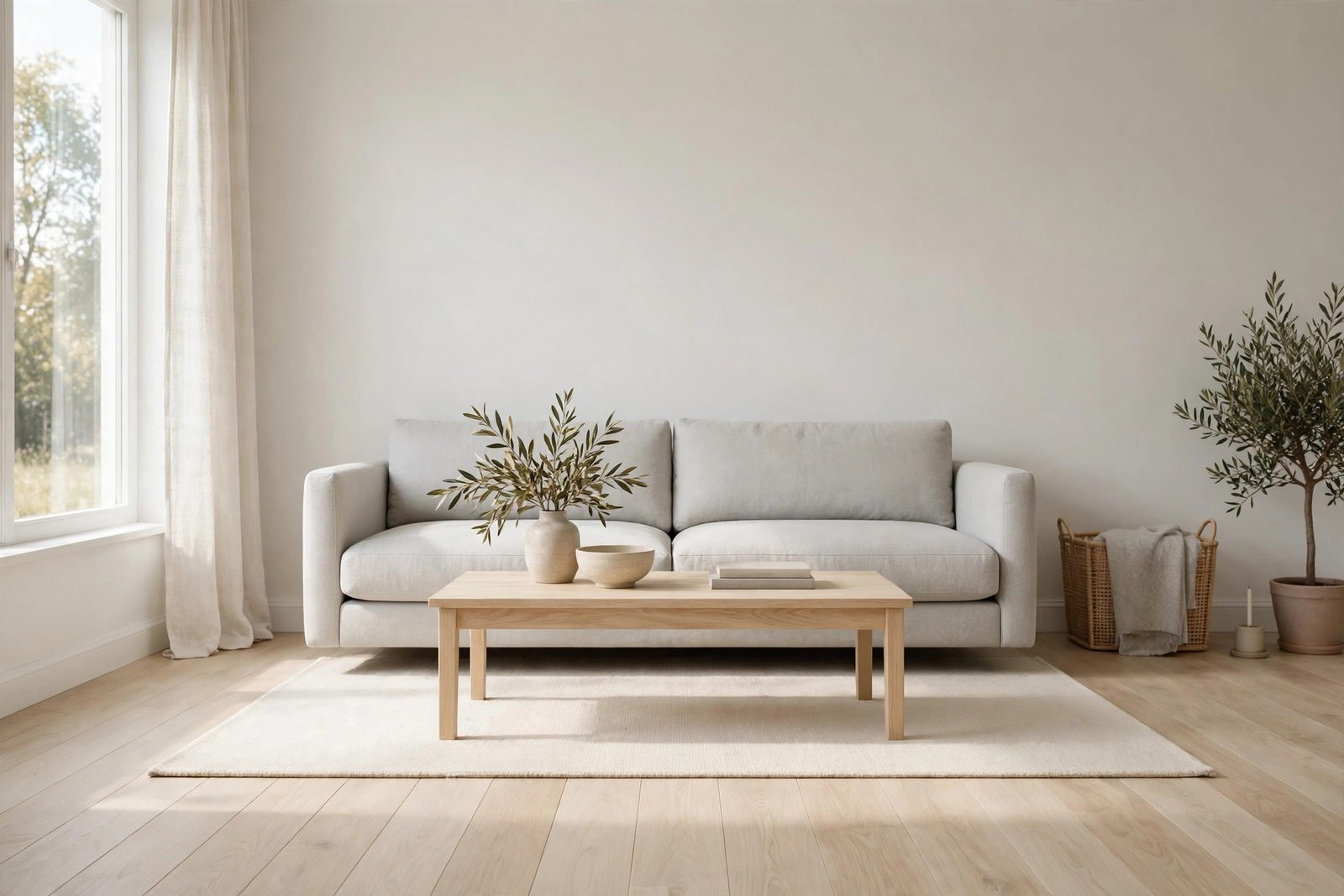
Scandinavian furniture is low, light and simple in shape. The classic sofa is a two- or three-seat piece with slim arms, straight lines, raised legs and a back that sits below the window sill. It is comfortable without being bulky, and the raised legs let the floor show underneath, which matters in a style where the floor is part of the look. When you are choosing the right sofa, check the depth as well as the length: a seat depth of about 21 to 23 inches suits most people, and anything deeper turns a calm sofa into a bed that nobody can sit upright on.
Chairs should match the sofa in scale, not necessarily in style. A slim armchair with light wood legs, or a simple dining-style chair pulled up beside the sofa, suits the style better than a deep, heavy recliner. The same rule applies to tables: a low, rectangular coffee table with clean edges, a small round side table, and nothing else in the centre of the room. A coffee table that is too tall or too wide breaks the low horizontal line that makes a Scandinavian room feel calm.
Leave space around the furniture. A Scandinavian room is not full. The gap between the sofa and the wall, the empty floor beside the coffee table, the clear corner by the window — these gaps are part of the design, not wasted space. If the room feels crowded, the answer is usually to remove one piece, not to rearrange the same pieces into a tighter group.
Layer textiles, not patterns
Textiles are where a Scandinavian room gets its warmth. A wool throw over the arm of the sofa, a linen cushion, a soft cotton blanket folded over a chair — each one adds a layer of texture without adding a pattern. The style uses texture instead of pattern: a knitted throw, a woven rug, a linen curtain, a sheepskin over a chair. A room with five textures and no pattern feels rich. A room with five patterns feels busy, however pale the colours are.
Keep the textile colours close to the room: white, cream, light grey, pale beige, and one soft muted tone such as dusty blue, sage green or warm blush. One muted accent is enough. A dusty-blue throw and a sage cushion in the same room are two accents competing, not one accent working. Choose the accent you like most, repeat it in two places — a cushion and a throw, for example — and leave the rest plain.
Choose natural fibres where you can. Wool, linen and cotton age better than shiny synthetics, and they look better in daylight, which is the light the room is built around. A wool rug under the coffee table, a linen cushion on the sofa, a cotton throw over the chair: three natural textures in three pale tones are the whole textile plan, and they do not need anything else.
Add one warm accent, not five
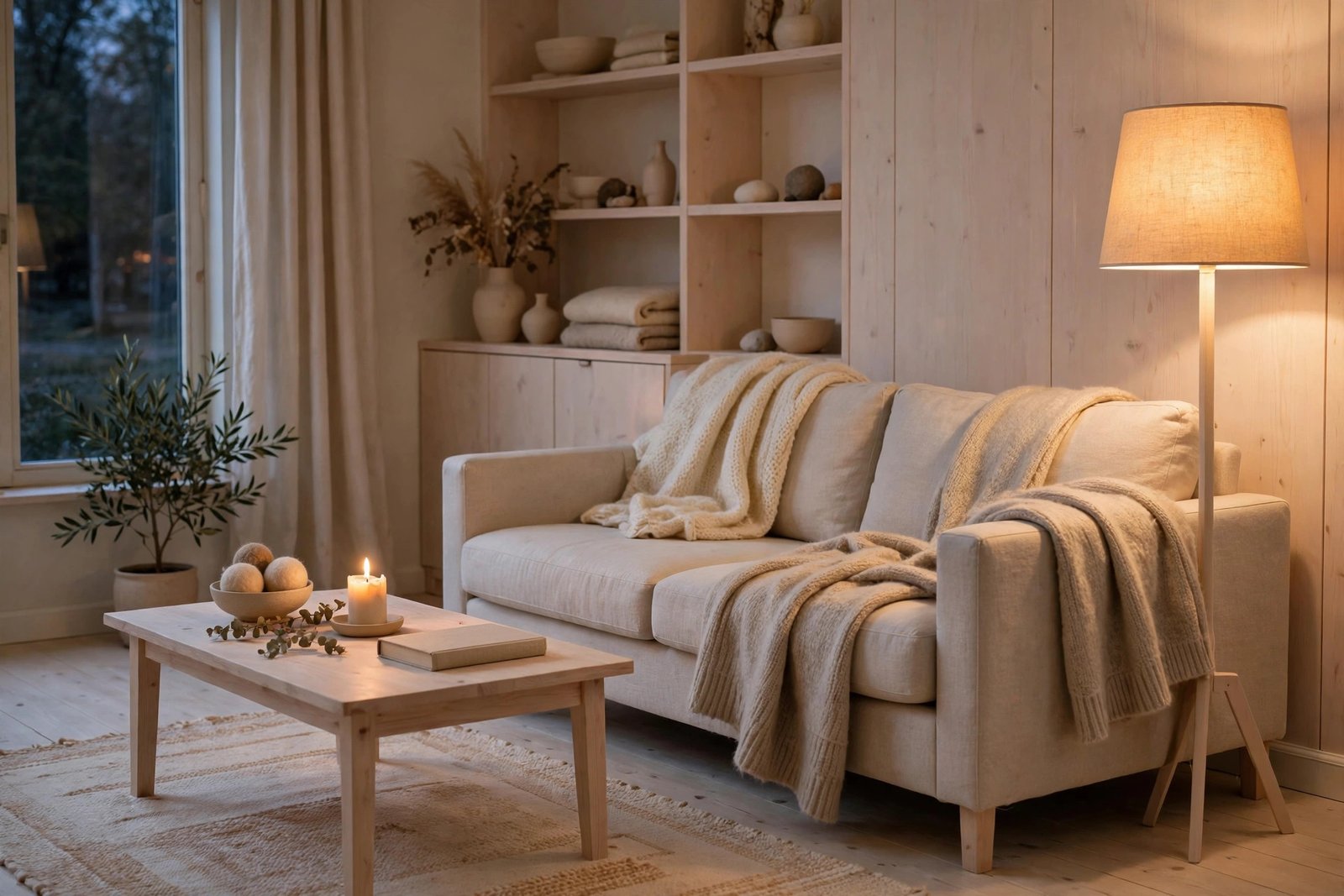
A pale room without a warm accent feels like a showroom. The accent can be small: a black floor lamp, a dark-framed picture, a brass candle holder, a deep green plant, or a single piece of art with a warm tone in it. The point is that there is one thing in the room with visual weight, so the eye has somewhere to land. When everything is equally pale, the eye wanders and the room feels unfinished.
Black is the most reliable accent in a Scandinavian room, used sparingly. A slim black floor lamp, black picture frames, or black handles on a pale cabinet give the room definition without adding colour. Brass and leather are the warm alternatives: a brass pendant, a tan leather cushion, a wooden bowl on the coffee table. Choose one family — black, brass or leather — and keep the accent to two or three objects at most. Five black objects are a theme. Fifteen are clutter.
Art should be simple and large rather than small and many. One large print, or one framed photograph, on the wall that faces the seating does more than a gallery wall of six small frames. The art can be abstract, a landscape, or a simple line drawing — what matters is that it has space around it, so it reads as one deliberate choice rather than one more thing on a full wall.
Let plants do the decorating
Plants are the most Scandinavian decoration there is, because they add life and colour without adding pattern or clutter. A tall green plant in a plain pot in the corner by the window, a small trailing plant on a shelf, a sprig of eucalyptus in a glass vase on the coffee table — each one brings a soft green into a pale room, and green suits every version of the palette, from white and grey to beige and dusty blue.
Choose plants that suit the light you have. A tall fiddle-leaf fig or a monstera needs the bright spot by the window. A snake plant or a pothos tolerates a darker corner. Buy the plant for the place, not for the photograph, and give it a plain pot — white, pale grey, terracotta or natural rattan. A patterned or brightly coloured pot fights the room, however beautiful the plant is.
Keep the number small. One tall plant, one medium plant and one small vase is a full plant plan for a living room. Ten small plants on every surface are a collection, not a style, and they turn the calm room into a greenhouse. The same restraint that governs the furniture governs the plants: one strong choice, repeated sparingly, beats a dozen small ones.
Dried stems are the low-maintenance alternative when a living plant will not survive the spot. A few dried eucalyptus stems, pampas grass or bare branches in a tall plain vase bring the same soft shape and muted green-grey tone into the room, and they need no light, no water and no care. They suit a dark corner where a living plant would struggle, and they last for months. Treat them the same way as living plants: one vase, one kind of stem, and a plain container. A bunch of dried stems mixed with fresh flowers and a patterned vase is three ideas at once, and the room does not need all three.
Keep surfaces almost empty
A Scandinavian coffee table holds one or two things: a book, a candle, a small vase, a wooden bowl. Not all four. A side table holds a lamp and nothing else, or a lamp and one book. A television console holds the television and one low object. The empty surface is not a sign that the room is unfinished — it is the style. Clear surfaces are what make the room feel calm, and a calm room is the whole aim.
Storage has to be closed to keep this working. Open shelves look good in photographs and turn into visual clutter within a week, because everything on display has to stay tidy. A pale cabinet with doors, a console with drawers, a basket under the side table — each one hides the real life of the room and lets the surfaces stay clear. If a piece of furniture has a surface, it needs a home nearby for what sits on it, or the surface will collect clutter and the calm will go with it.
Do a weekly reset. Take everything off the coffee table and the side tables, put back only the one or two things that belong there, and return the rest to its home. It takes five minutes and it is the single habit that keeps a Scandinavian room looking like itself. The style is not a one-time purchase — it is a habit of putting things away.
Layer the light for the evening
A Scandinavian room is designed for daylight, but it has to work after dark too, and after dark it needs layered light. One ceiling light leaves the room flat and shadowy by late afternoon. Layer it instead: a ceiling fixture for general brightness, a floor lamp beside the sofa for reading, and a small table lamp or a candle on the console for the evening. Three sources of light at three different heights make the room feel warm and complete, because the eye can see the whole room instead of one bright pool in the middle.
Warm light matters more than bright light. A warm white bulb, around 2700K, makes a pale room feel comfortable in the evening. A cool white bulb makes the same room feel like an office. Keep all the bulbs in the room the same warmth, so the light does not change colour from one corner to the next. When you are choosing the right ceiling light for the room, keep it slim and close to the ceiling — a large pendant hangs down into the room and makes the ceiling feel lower, while a slim flush fixture gives the light without taking the height.
Candles are part of the style, not an extra. A lit candle on the coffee table or the console in the evening is the classic Scandinavian touch, and it costs almost nothing. Use real candles in simple holders, keep them away from curtains and throws, and never leave them burning unattended. One candle, lit in the evening, does more for the atmosphere of the room than any single piece of furniture.
A simple plan to start this weekend
Do not redecorate the living room this weekend. Do the four things that cost almost nothing and change how the room feels by Monday. First, clear the window completely — move anything in front of it, take down heavy curtains, and clean the glass. Second, take everything off the coffee table and the side tables, then put back only one thing per surface. Third, remove one piece of furniture, or one pattern, from the room and live without it for two weeks. Fourth, add one textile — a wool throw or a linen cushion — in a pale tone, and one plant in a plain pot by the window.
Live with that version for two weeks before spending anything bigger. You will learn whether the room needs more warmth or more light, whether the sofa is genuinely the right shape, and which wall deserves the one piece of art. The style sits between our japandi living room ideas and the broader interior design styles guide on this site — calmer than most styles, warmer than pure minimalism — and it rewards the same patience: change one thing, live with it, then change the next.
A Scandinavian living room rewards restraint, not spending. Light first, pale wood second, clean shapes third, textiles and one warm accent last. Follow that order and the same square footage feels brighter, calmer and easier to live in — which is the whole point of the exercise.
Frequently asked questions
What colours define a Scandinavian living room?
Warm white or very pale grey on the walls, pale wood on the floor and furniture, and soft textiles in white, cream, light grey or pale beige, with one muted accent such as dusty blue, sage green or warm blush. Keep the palette to two light colours plus the one accent — every extra colour is another visual edge, and in a pale room each edge makes the space feel smaller.
How do I make a Scandinavian living room feel warm, not cold?
Add texture and one warm accent, not more colour. A wool throw, a linen cushion, a pale wood table and a lit candle in the evening do the work. A black floor lamp, a brass holder or a tan leather cushion gives the eye one warm thing to land on, and a green plant brings life into the pale palette without adding pattern.
What furniture suits a Scandinavian living room?
Low, light furniture with clean shapes: a two- or three-seat sofa with slim arms and raised legs, a slim armchair with light wood legs, and a low rectangular coffee table with clean edges. Leave space around the pieces — the gaps between the furniture are part of the design, not wasted space.
Can a Scandinavian living room work in a small room?
Yes — the style suits small rooms well, because it is built on light colours, low furniture and clear surfaces. The same small-space rules apply: measure first, choose furniture by scale, build storage up the walls with closed cabinets, and leave one wall mostly empty. A small Scandinavian room feels larger than a small room in a busier style.
Do I need a lot of white in a Scandinavian living room?
White is the base, but the room should not be all white. Pale wood, soft textiles in cream and grey, a muted accent and a green plant are what keep the white from feeling stark. If the room feels cold, the answer is usually more texture and warmer light, not more white paint.
How many plants should a Scandinavian living room have?
One tall plant, one medium plant and one small vase is a full plan for a living room. Choose plants that suit the light in each spot — a tall plant by the window, a tolerant plant in a darker corner — and keep the pots plain. Ten small plants on every surface turn a calm room into a greenhouse.
Pingback: Modern Farmhouse Living Room Ideas: Warm and Relaxed