
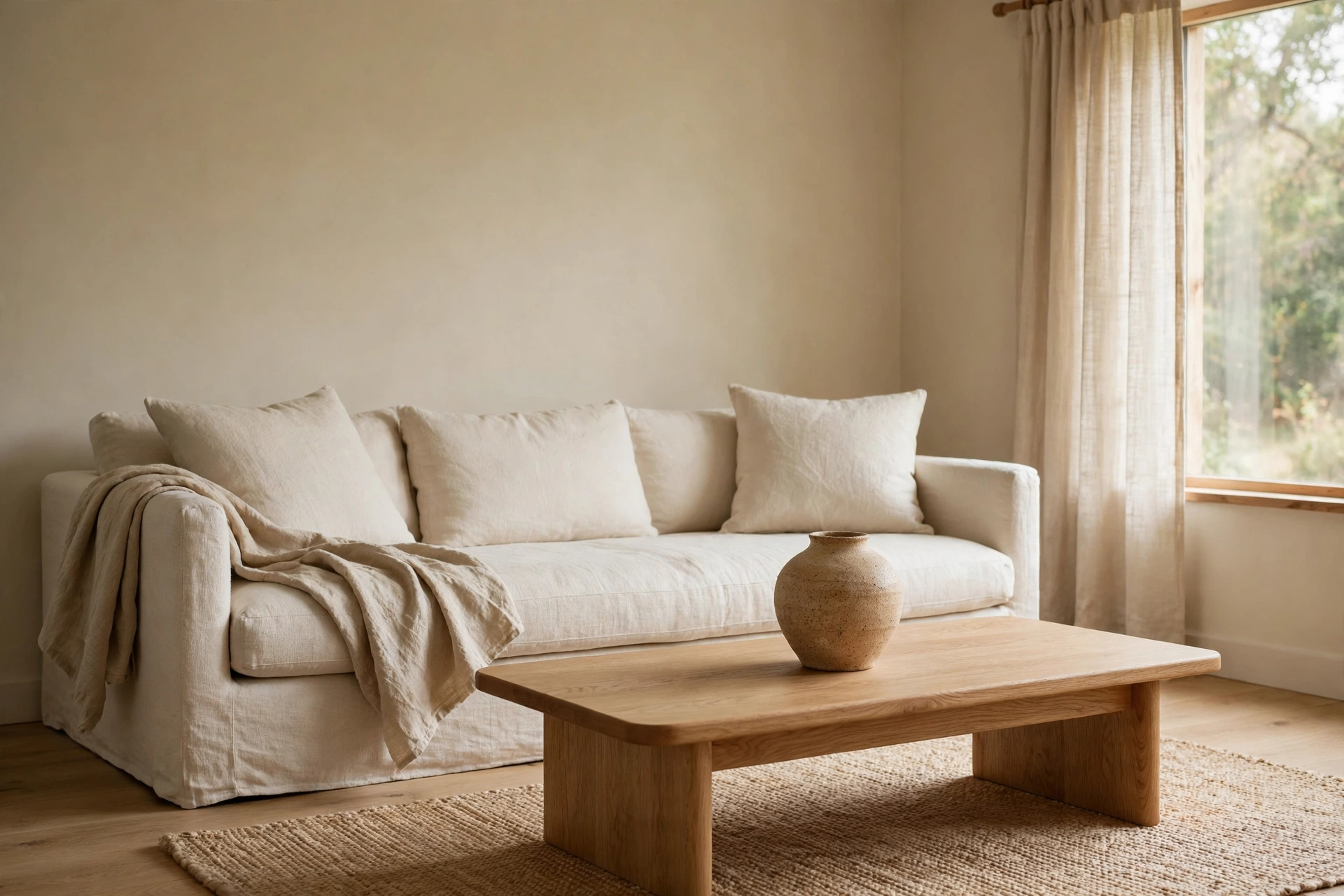
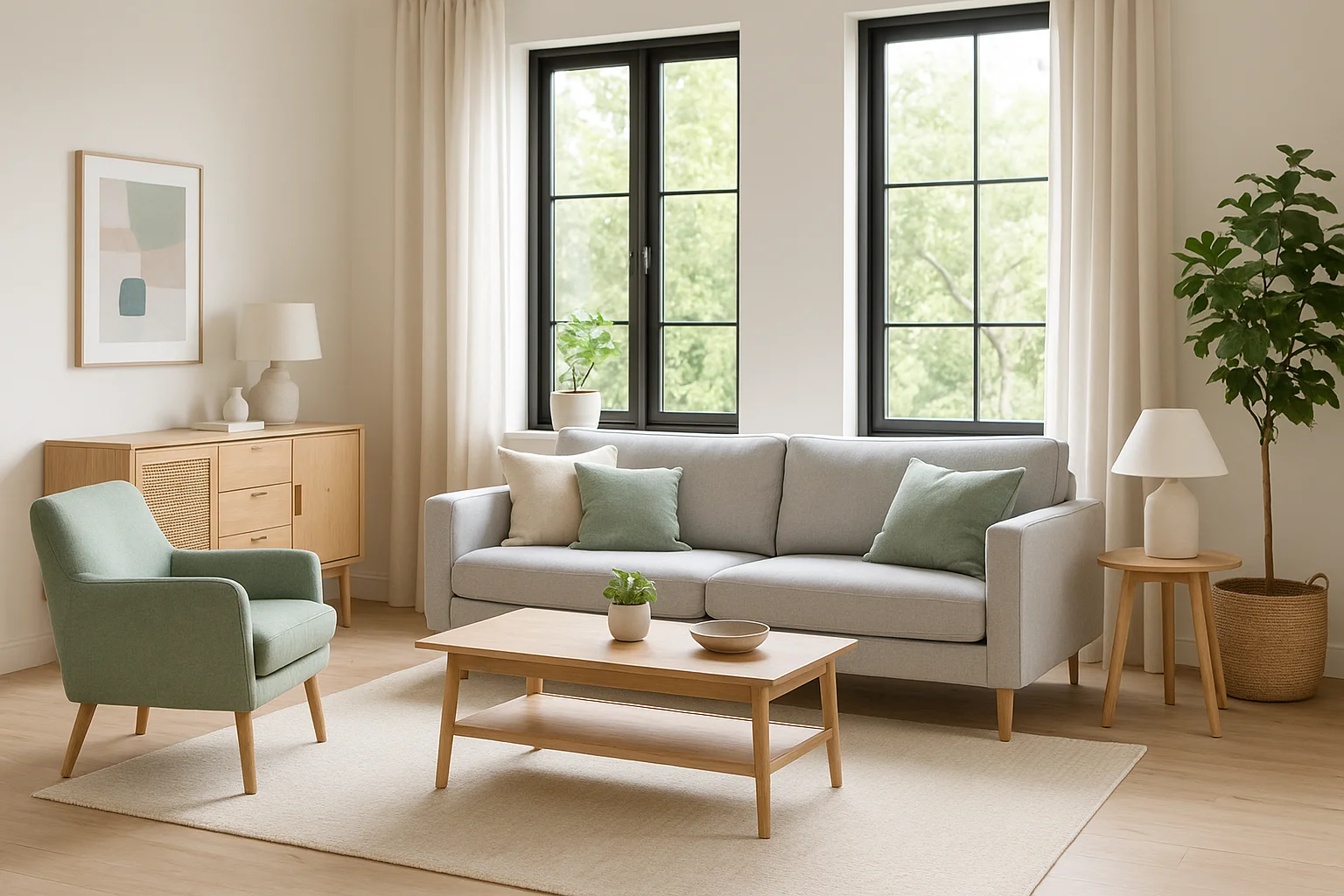
A Japandi living room is calm without being cold. It takes the restraint and low, grounded lines of Japanese design and joins them to the warmth and comfort of Scandinavian design, so the room feels quiet, lived-in, and easy to relax in. The formula is simple to state and easy to get wrong: warm neutrals instead of stark white, furniture that sits low, natural materials instead of decoration, and one strong focal piece with plenty of open space around it.
This guide works through that formula in the order that matters. Start with the palette, then the furniture heights, then the materials, then the focal point and storage, then the light. If you copy a Japandi photo and buy the sofa first, you usually end up with a beige room that still feels busy. Get the order right and even a small or rented living room can hold the look.
What Japandi actually is
Japandi is a blend of two traditions that agree on more than they differ on. Japanese design brings restraint, low lines, empty space, and an appreciation for imperfect, natural materials — the wabi-sabi idea that a handmade, slightly irregular bowl is more beautiful than a flawless factory one. Scandinavian design brings comfort, soft textiles, pale wood, and the hygge idea that a room should invite you to sit down and stay. Japandi keeps the Japanese discipline and the Scandinavian warmth, and drops the parts that fight each other.
That is why a true Japandi living room is never sparse or showroom-perfect. It is not minimalism with the personality removed. It is a room where every object has a job, surfaces stay mostly clear, and the few things on display are there because they are useful or beautiful by hand, not because a styling photo had them. If a piece does not earn its place, it goes into closed storage or it goes.
Start with a warm, quiet palette
Build the palette on warm neutrals: creamy off-whites, warm chalk, sandy beige, warm greige, mushroom, and soft taupe. Never use a cool, blue-toned white — it reads clinical and fights the wood. Layer the neutrals with natural wood tones, from pale oak and ash to deeper walnut, and ground the room with one dark accent in charcoal, slate, or soft black. Muted additions in sage, clay, terracotta, or dusty blue are welcome in small doses; bright or saturated colour is not.
One dark anchor matters more than most people expect. Pale walls and an oatmeal sofa make a Japandi living room feel calm, but without contrast they make it feel unresolved. Give the neutrals something to lean against: a smoked-oak low shelf, a charcoal linen throw, or a matte black bowl on the coffee table. One anchor is enough. Two or three dark statements in the same small room start competing with each other.
The same palette logic helps in other small rooms. Our small bedroom design ideas use the same warm, continuous colour to make a room read as one volume, and the approach transfers directly.
Bring the furniture down low
Low furniture is the clearest Japandi signature. A low-profile sofa, close to the floor with clean straight lines and no rolled arms or tufting, pulls the eye toward the floor and makes the ceiling feel higher without moving a wall. Upholstery in natural linen, cotton, or boucle in cream, stone, or oatmeal keeps the sofa inside the palette while adding the textile texture the style depends on.
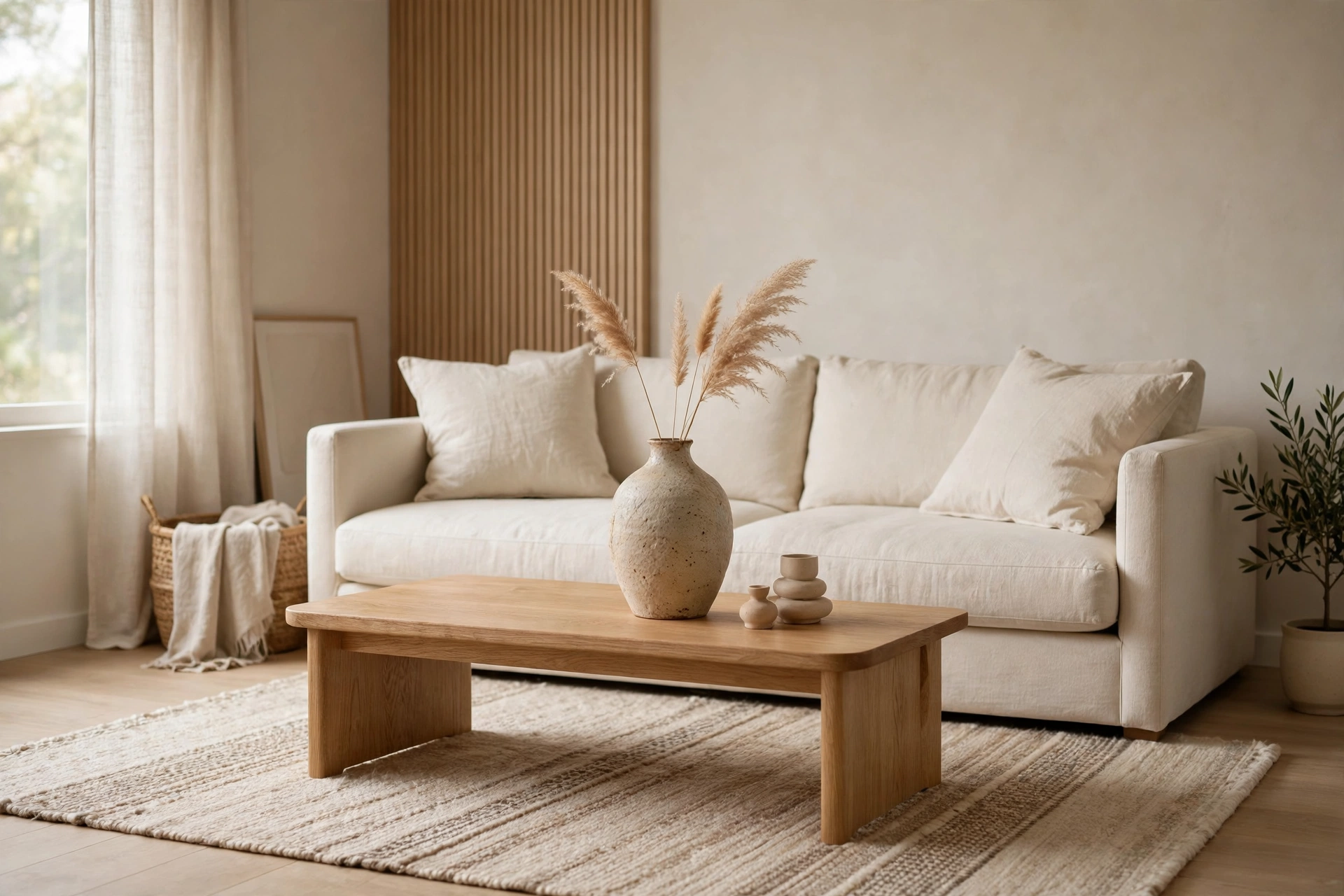
Match the coffee table to the sofa. A low, rectangular table in solid natural wood — many Japandi tables sit around 10 to 16 inches high, lower than the typical coffee table — keeps the whole seating group at one calm eye level. Style it with restraint: one handmade bowl, one book, nothing else. A table covered in remotes, coasters, and magazines breaks the line the low furniture was built to create.
Floor cushions and a low bench can replace extra chairs in a small room. They keep sightlines open, they store flat, and they reinforce the grounded feeling. The same low, uncluttered approach is what makes a small living room feel bigger without renovation — fewer tall objects, more visible floor.
Let natural materials do the decorating
Wood comes first. Oak, walnut, ash, and bamboo, in matte finishes with visible grain, do more work in a Japandi living room than any accessory. A common approach is a light main tone — oak floors or shelving — with one or two darker walnut pieces for depth. Stone and marble work as accents: a travertine side-table top, a concrete planter, a stone candle holder. Used sparingly, they add weight without visual noise.
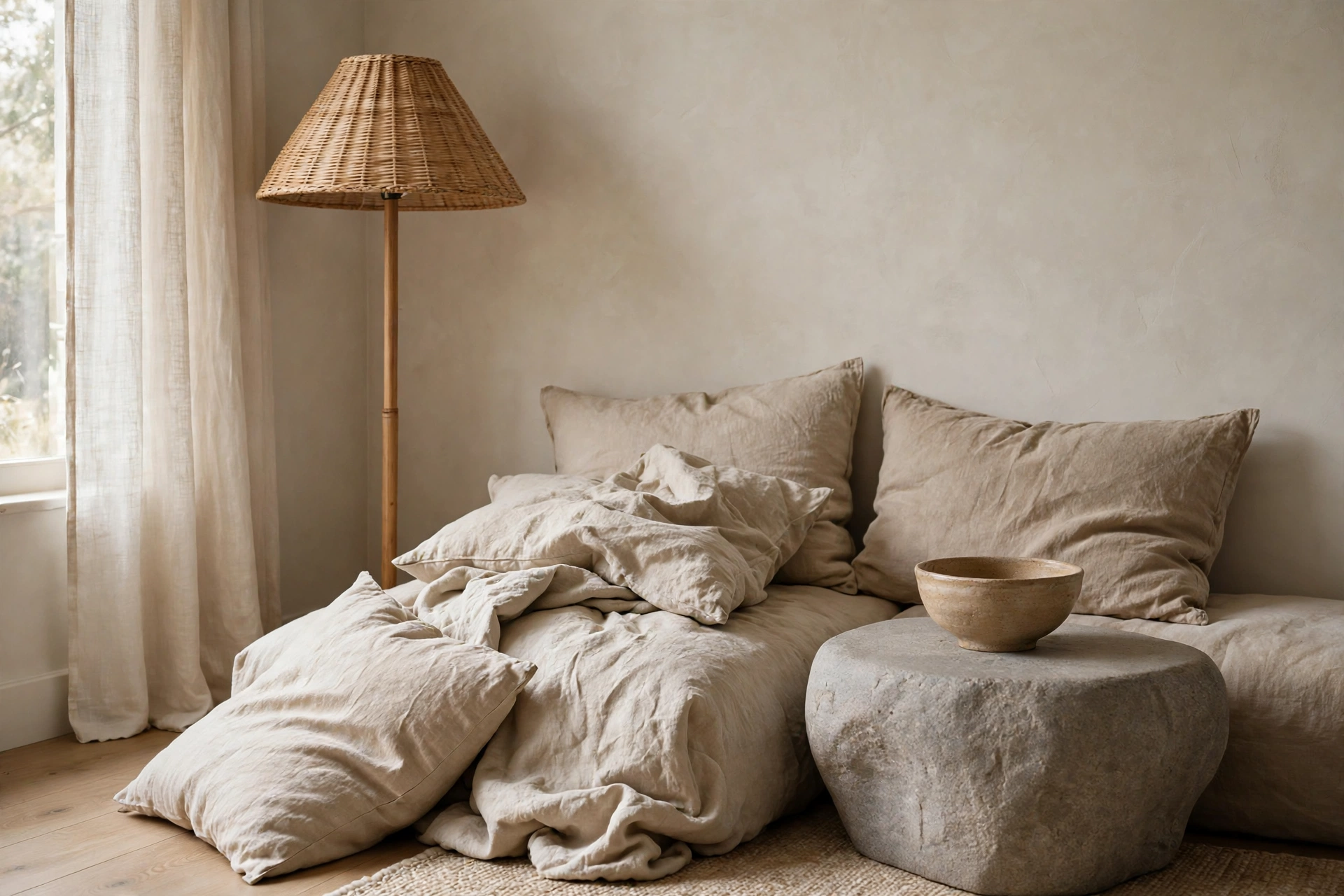
Textiles carry the softness. Linen is the essential Japandi fabric — cushion covers, throws, and curtains, never crisp, always slightly rumpled. Add a nubby boucle pillow, a cotton throw, and a wool or jute rug, and the room gets its texture from touch rather than pattern. Rattan and wicker add organic warmth without visual weight; a single rattan lamp or side table is usually enough.
Ceramics are the finishing material. Handmade, slightly imperfect bowls, vases, and mugs are wabi-sabi in object form, and one or two on a shelf or table give the room its hand-finished note. Paper and bamboo round it out — a paper-shade lamp, bamboo blinds, a woven tray. The rule for all of it: natural, matte, and few. High-gloss finishes and busy patterns pull the room out of the style immediately.
One handcrafted focal piece, and empty space around it
Japandi rooms usually have a clear focal point, and it is often furniture rather than art: a sculptural coffee table, a carved cabinet, or a live-edge bench that the rest of the room supports. Give that piece the wall or the centre, keep the surrounding surfaces nearly bare, and let the open space do its work. A room that feels restful rather than empty is a room where the empty space was planned, not leftover.
Closed storage is what makes the calm sustainable. Everyday clutter — remotes, chargers, toys, paperwork — belongs in closed baskets, low cabinets, and drawers, not on open shelves. Open shelving in a Japandi room holds a few chosen objects with space between them; everything else is behind a door. This is the same storage discipline behind solving small kitchen problems with one custom island — one well-planned storage piece beats five small ones.
Light: daylight first, warm lamps second
Japandi light is soft and layered. Maximise daylight with undyed linen curtains that diffuse rather than block, and keep window treatments light in colour and texture. In the evening, use warm lamps at low level — a paper-shade floor lamp, a small lamp on a side table — instead of one bright ceiling light. Light that comes from low and warm keeps the grounded feeling; a single overhead source flattens the room.
Pendant lights can work in a Japandi scheme when they stay quiet: a simple paper, rattan, or matte-metal shade in a warm neutral, hung low enough to define a zone without dominating it. Our guide to pendant lights for kitchen islands covers sizing and height in detail, and the same proportions apply over a low dining table in an open-plan Japandi space — the style also suits a calm kitchen, as our small kitchen design ideas show, where warm neutrals and closed storage do the same work.
Japandi vs Scandinavian vs minimalist
These three are confused constantly, and the differences are practical. Scandinavian design is brighter and cosier: white walls, pale wood, wool and sheepskin, standard furniture heights, built for long dark winters. Japanese design is lower and darker, with restraint and empty space at the centre. Japandi sits between them: warmer neutrals than Scandinavian, darker accents and lower furniture than either, and more textile warmth than strict minimalism. Minimalism, by contrast, is about removing objects; Japandi is about choosing natural ones. A minimalist room can feel cold. A Japandi room is meant to feel like it is waiting for you to sit down.
Common japandi living room mistakes
The first mistake is all-beige with no anchor, which reads as unfinished rather than calm. The second is cool white paint, which turns the wood yellow and the room clinical. The third is buying tall, standard-height furniture and expecting the style to survive it — height is the style. The fourth is filling every surface because the room “needs something”: in Japandi, the empty surface is the something. The fifth is mixing in glossy, chrome, or brightly coloured pieces that belong to a different style entirely. Pick the palette, the heights, and the materials, and hold the line.
Frequently asked questions
What colours are used in a Japandi living room?
Warm whites, greige, sand, clay, and mushroom tones form the base, with natural wood in light and dark tones adding warmth. Charcoal, slate, or soft black works as a small dark anchor, and muted sage, terracotta, or dusty blue can appear in tiny doses. Bright, saturated colours and cool blue-toned whites are avoided.
Is Japandi good for a small living room?
Yes — it is one of the best styles for small rooms. Low furniture makes ceilings feel higher, warm continuous colour makes walls read as one volume, and closed storage keeps the small footprint from looking cluttered. The style asks for fewer, lower pieces, which is exactly what a small room needs.
What furniture defines a Japandi living room?
A low-profile sofa with clean lines, a low solid-wood coffee table, and one handcrafted focal piece such as a carved cabinet or live-edge bench. Floor cushions and low benches can replace extra chairs. Upholstery in linen, cotton, or boucle and matte natural-wood finishes keep the group inside the style.
How is Japandi different from Scandinavian?
Scandinavian is brighter: white walls, pale wood, standard heights, wool and sheepskin. Japandi is warmer and lower: warm neutrals instead of white, a dark anchor, furniture closer to the floor, and Japanese restraint about empty space. Japandi can be read as Scandinavian comfort with Japanese discipline added.
Can I rent and still do Japandi?
Yes. The style is mostly furniture, textiles, and lamps rather than built work. A low sofa, a low wood table, linen curtains on a tension or removable rod, closed baskets for clutter, and warm lamps will carry the look in a rental. Avoid permanent changes; the palette can come from throws, cushions, and a rug.
What should I avoid in a Japandi living room?
Cool-toned whites, bright accent colours, high-gloss finishes, tall bulky furniture, busy patterns, and cluttered surfaces. Also avoid copying every object from a styling photo — Japandi works when the few objects present are natural, useful, or handmade, not when the room is filled with lookalike decor.
Pingback: Interior Design Styles Guide: 12 Popular Looks Explained