When homeowners discuss residential design, the conversation often revolves around kitchens, living rooms, primary suites, or outdoor spaces. Yet some of the most successful homes are not defined by individual rooms at all.
Experienced architects involved in custom residential design often focus on something less obvious: the transitions between spaces. The quality of a home is frequently shaped by how occupants move through it, how views are revealed, how privacy is layered, and how light, volume, and circulation change throughout the day.
The most memorable homes are rarely collections of impressive rooms. Instead, they are carefully choreographed experiences that guide people through space in a deliberate and intuitive way.
The Difference Between Houses and Experiences
Many homes are designed as a series of rooms connected by circulation space.
Architecturally successful homes are planned differently. Rather than treating hallways, thresholds, stair landings, and transitional zones as leftover square footage, designers often use these moments to create anticipation, visual hierarchy, and a stronger sense of place.
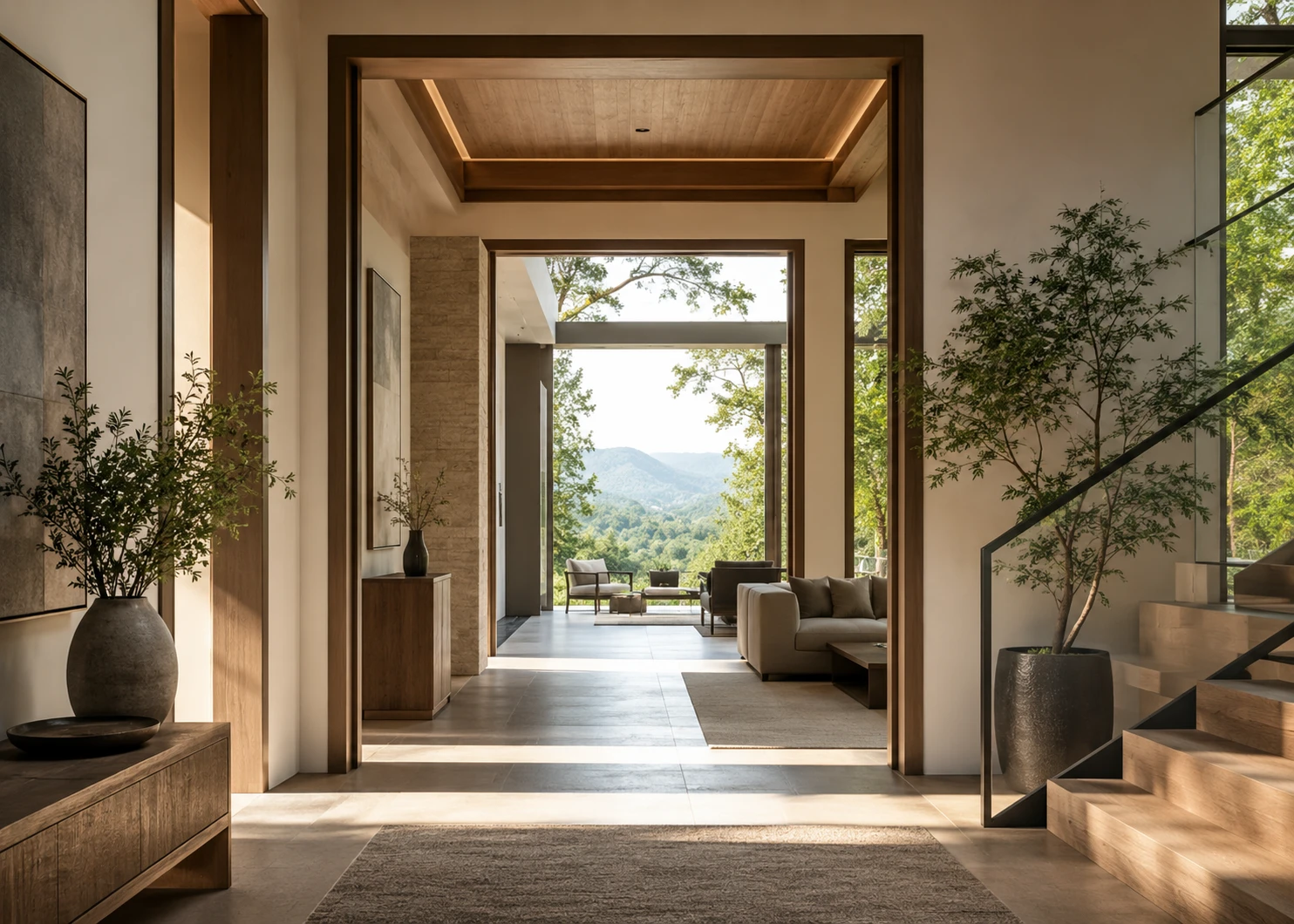
A carefully framed view at the end of a corridor, a gradual shift in ceiling height, or a subtle transition between public and private zones can have a greater impact on how a home feels than adding hundreds of square feet to the floor plan.
The Architecture of Movement
One of the most overlooked aspects of residential design is circulation. While homeowners naturally focus on rooms and finishes, architects often spend just as much time studying how people move through a home.
Every doorway, corridor, staircase, and transition influences the daily experience of the space. Poor circulation can make a home feel fragmented, regardless of its size. Well-planned circulation, on the other hand, creates a sense of flow that feels effortless and intuitive.
In high-performing residential architecture, movement is rarely accidental. Primary living spaces are positioned to encourage natural gathering, private areas are buffered from busy zones, and circulation paths are designed to minimize unnecessary travel throughout the home.
The result is a house that not only looks better on paper but functions more comfortably in everyday life.
Creating Hierarchy Through Space
Successful homes also establish a clear hierarchy between different types of spaces.
Public areas such as entry foyers, kitchens, dining rooms, and living spaces are typically organized around openness, visibility, and connection. Private areas, including bedrooms, home offices, and retreat spaces, often benefit from greater separation and controlled access.
Rather than relying solely on walls and doors, architects frequently use spatial relationships, ceiling variations, sight lines, and orientation to define these zones.
This subtle hierarchy helps create homes that feel organized and balanced without becoming overly compartmentalized.
Why Transitional Spaces Matter
Transitional spaces are often viewed as circulation areas that simply connect rooms. In reality, they can become some of the most important architectural moments within a home.
A carefully designed hallway can frame a view. A staircase landing can introduce natural light into the center of a floor plan. A transition between indoor and outdoor spaces can strengthen the connection between architecture and landscape.
These moments create rhythm throughout a home and contribute to a richer spatial experience. They also help prevent interiors from feeling repetitive or predictable, regardless of square footage.
In many of the most memorable residential projects, the spaces between rooms are just as carefully considered as the rooms themselves.
How Architects Control What You See
One of the defining characteristics of thoughtful residential architecture is the deliberate control of views and sight lines.
When entering a home, people rarely absorb an entire space at once. Instead, they experience a sequence of carefully revealed moments. A glimpse of a courtyard, a framed view toward a living area, or a visual connection to a distant landscape can make a home feel larger, more layered, and more engaging.
This principle is frequently used in both contemporary and traditional architecture. Rather than exposing every room immediately, successful homes reveal spaces gradually, creating a stronger sense of depth and discovery.
The result is an environment that feels richer and more dynamic regardless of its actual size.
Why Luxury Often Feels Quiet
Many homeowners associate luxury with larger rooms, premium finishes, or statement features. However, some of the most successful residential projects achieve a sense of luxury through restraint.
Visual noise often makes interiors feel smaller and more stressful. Excessive material changes, unnecessary architectural details, and competing focal points can overwhelm a space and reduce its overall impact.
By contrast, homes that feel timeless often rely on a limited palette of materials, consistent proportions, and a clear architectural language throughout the project.
This creates a sense of calm that is difficult to quantify but immediately noticeable when experienced.
The Importance of Sequence
Architecture is experienced over time.
Unlike a photograph, a home is never viewed from a single angle. People arrive, move, gather, work, relax, and interact with spaces throughout the day.
For this reason, architects frequently think in terms of sequence rather than individual rooms. The experience of moving from the entry into the main living area, transitioning from public spaces into private retreats, or connecting interior environments with outdoor spaces often defines how memorable a home becomes.
The most successful projects are designed to support these transitions naturally, creating an experience that feels intuitive rather than forced.
Designing for Daily Life
Ultimately, great residential architecture is not about creating impressive spaces for occasional use. It is about improving everyday life.
The kitchen used every morning, the transition from work to family space, the privacy of a bedroom suite, or the connection between indoor and outdoor living areas often have a greater impact on long-term satisfaction than any individual design feature.
Homes that continue to perform well years after construction are usually the result of careful planning, strong spatial organization, and a clear understanding of how occupants will actually use the space.
Conclusion
The most memorable homes are rarely defined by individual rooms, expensive finishes, or overall square footage. Instead, they are shaped by the relationships between spaces, the sequence of movement, the control of views, and the subtle transitions that guide daily life.
When these elements are carefully considered, architecture becomes more than a collection of rooms. It becomes an experience—one that feels comfortable, intuitive, and timeless long after construction is complete.