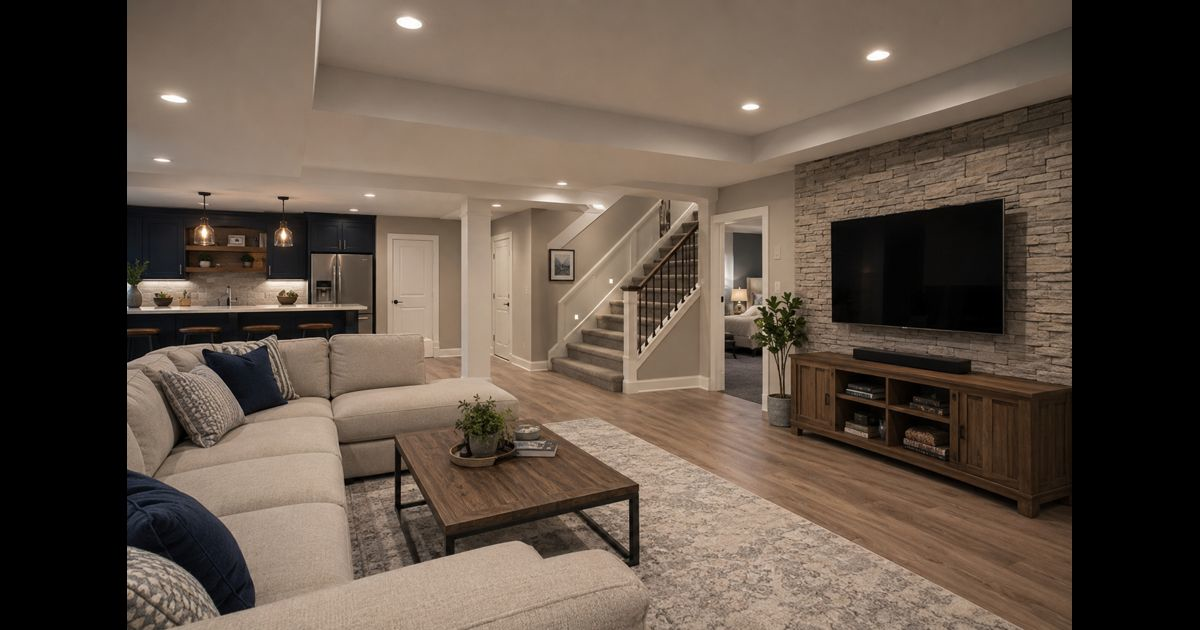
Here’s the belief almost every homeowner starts with: spend $50,000 finishing the basement, add $50,000 to the home’s value. Clean, even, done.
The data says otherwise. And once you understand why, you’ll make much smarter choices about what to build.
The real number
The most-cited benchmark is Remodeling Magazine’s Cost vs. Value Report (produced with Zonda and the Journal of Light Construction). The 2025 edition puts a mid-range basement conversion at roughly 71% cost recovery nationally. Spend about $70,000, add roughly $50,000 at resale.
That’s not a bad return. On a percentage basis, it beats most kitchen and bathroom remodels. But it’s not the dollar-for-dollar payback the myth promises.
You may see an older 86% figure floating around from a 2022 National Association of Realtors report. Costs and market conditions have shifted since, so treat 70–75% as the honest current range, not 86%.
And the spread is wide. Depending on your region and the quality of the work, recovery runs anywhere from the low 20s to the low 80s in percentage terms. Location does a lot of the heavy lifting.
Why the gap exists: the square footage rule
Here’s the part most articles skip. The reason a finished basement rarely pays back fully comes down to how appraisers are required to measure your home.
Since April 2022, Fannie Mae has required appraisers to follow the ANSI Z765 measuring standard on most single-family appraisals. The rule is blunt: if any part of a level sits below ground, the entire level is “below grade,” a basement, no matter how nicely it’s finished.
That means your basement almost never counts toward Gross Living Area (GLA), the above-grade square footage that drives price-per-square-foot comparisons.
The surprise for a lot of homeowners: this includes walkout basements. If one side is below grade, the whole level is still a basement in the appraisal.
So a beautiful 800-square-foot finished basement doesn’t get added to your home’s “official” square footage. It gets reported on a separate line and valued on its own, and below-grade space almost always trades at a lower price per square foot than above-grade space.
The value most people miss
Below-grade doesn’t mean no value. Appraisers still assign a dollar figure to finished basement space; it just lives on a different line of the report.
And two indirect effects can quietly close the gap.
First, if you add a legal bedroom or a full bathroom down there, you may push the home into a higher bedroom- or bathroom-count tier, where it competes with more expensive comparable homes.
Second, a clean, finished, move-in-ready basement can widen your buyer pool and shorten your time on market. That edge doesn’t show up in the ROI percentage, but it shows up in how fast you sell.
What appraisers reward, and what they ignore
Not all finishes are treated equally. If resale value is the goal, spend where the rules actually give you credit.
Appraisers tend to reward:
-
Egress windows. Required to call a basement room a legal bedroom, which is where the real value lives.
-
Proper ceiling height. Finished space generally needs at least 7 feet to be treated as quality living area; low ceilings get discounted or excluded.
-
A full or half bathroom. Moves you up a bathroom-count tier.
-
Finishes and heating that match the rest of the house. Permanent HVAC, drywall, quality flooring.
-
Permits. Unpermitted work often gets little to no credit, and it spooks buyers.
Appraisers tend to ignore or discount:
-
A “bedroom” with no egress window (it’s just a room).
-
Cosmetic upgrades under ceilings below 7 feet.
-
High-end theater or bar build-outs that outrun the neighborhood’s price ceiling.
-
DIY framing, wiring, or plumbing that isn’t up to code.
How to make the money back
If you’re weighing South Shore Basement Finishing against other projects, here’s a practical order of operations.
-
Pull your region’s number. Look up the current Cost vs. Value data for your area, not the national average.
-
Ask before you spend. A local appraiser or agent can tell you how below-grade space is actually trading in your market right now.
-
Prioritize the value-drivers: egress windows, code ceiling height, a bathroom, and at least one legal bedroom.
-
Permit everything and hire licensed basement finishing services for framing, electrical, and plumbing. Unpermitted work erodes your return.
-
Don’t overbuild past the neighborhood. Match comparable finished homes; don’t exceed them.
Finishing a basement is one of the better interior investments you can make, just not a break-even one. Expect to recover roughly 70–75% of your cost, earn value on a separate appraisal line rather than in your headline square footage, and make most of your money back through a legal bedroom, a bath, and a faster sale.
Build for how the home is actually measured, and the return takes care of itself.