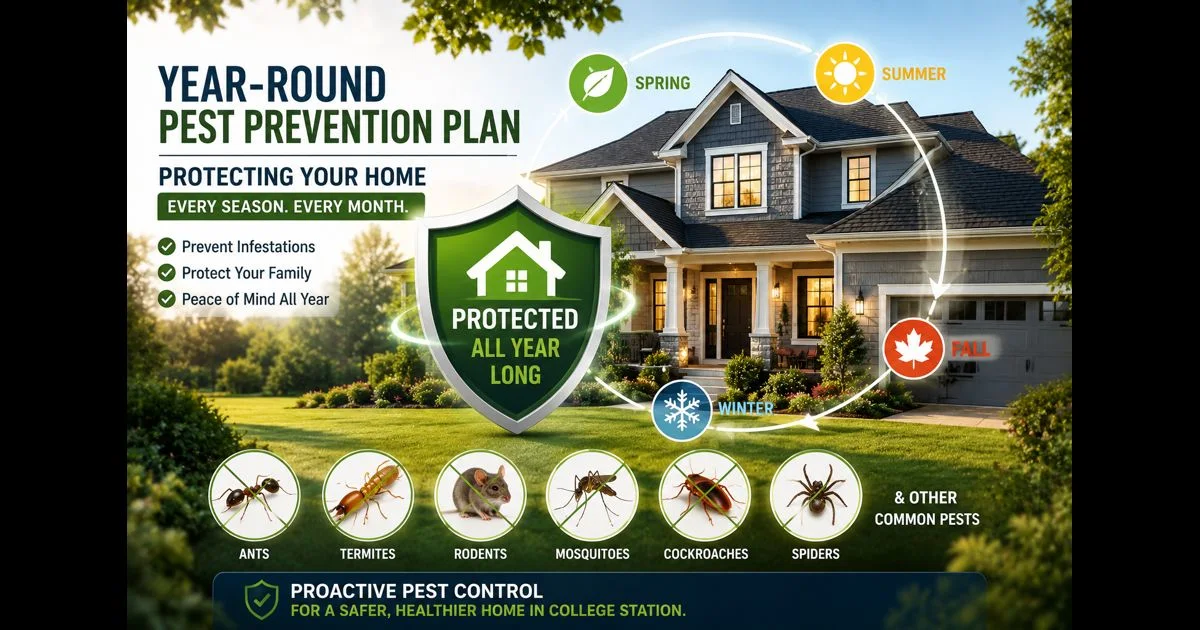
Pest problems are often treated as seasonal inconveniences. A homeowner notices ants in the kitchen during summer, mosquitoes in the backyard after heavy rain, or rodents near the garage when temperatures fall. Once the immediate activity disappears, it is easy to assume the problem has been resolved.
In reality, many pests remain active around College Station homes throughout the year. Their behavior may change with temperature, rainfall, access to food, and available shelter, but the underlying risk does not disappear when one season ends.
A year-round pest prevention plan focuses on identifying the conditions that attract pests, limiting the ways they enter a property, and addressing activity before it becomes a larger infestation. This approach is usually more effective than waiting for visible pests to appear and responding to each problem separately.
Why Pest Problems in College Station Are Not Limited to One Season
College Station experiences long periods of warm weather, changing humidity levels, and occasional heavy rainfall. These conditions can support many common insects and other pests during much of the year.
Hot or dry weather may push ants, cockroaches, and spiders indoors in search of water and more stable conditions. Rain can disturb outdoor nests and create standing water where mosquitoes reproduce. Cooler periods may encourage rodents and other pests to look for protected spaces inside garages, attics, wall voids, and storage areas.
Even when pests are not immediately visible, they may still be active around foundations, landscaping, utility openings, rooflines, and other sheltered parts of a property.
Homeowners who repeatedly notice activity in different rooms or during different seasons may benefit from professional pest control in College Station, TX that addresses both the current infestation and the conditions allowing pests to return.
The Most Common Pest Pressures Around Local Homes
A complete prevention strategy should account for more than one type of pest. Treating only the insect or animal currently visible may leave other vulnerabilities unresolved.
Ants
Ants can enter through extremely small cracks around windows, doors, foundations, plumbing lines, and utility penetrations. Once they locate a dependable source of food or moisture, they may establish trails between an outdoor colony and an indoor feeding area.
Removing visible ants may provide temporary relief, but it does not necessarily eliminate the colony. Long-term control usually requires identifying where the ants are coming from, removing attractants, sealing entry points, and selecting a treatment suited to the species involved.
Cockroaches
Cockroaches are commonly associated with kitchens and bathrooms because these areas provide food, water, warmth, and shelter. However, they may also hide in garages, storage areas, wall voids, drains, appliance spaces, and cardboard boxes.
Good sanitation is important, but cleanliness alone may not solve an established infestation. Cockroaches can survive on very small amounts of food and moisture, making hidden leaks, crumbs beneath appliances, pet food, and improperly stored waste important risk factors.
Spiders
Most spiders enter homes because suitable shelter and prey are available. A property with high insect activity can also support more spiders around exterior lights, rooflines, garages, porches, and storage areas.
Reducing spiders often requires a broader strategy that includes removing webs, limiting clutter, sealing gaps, and controlling the insects they feed on. Simply removing one visible spider does little to address the surrounding conditions.
Rodents
Mice and rats can enter structures through surprisingly small openings. Gaps around garage doors, rooflines, vents, plumbing penetrations, and damaged exterior materials may all provide access.
Once indoors, rodents may contaminate stored food, damage insulation, disturb storage areas, and gnaw on building materials. Prevention should therefore include both removal and exclusion. Without sealing the access point, new rodents may continue entering after the original problem has been addressed.
Mosquitoes, Fleas, and Ticks
Outdoor biting pests can make patios, lawns, and play areas difficult to enjoy. Mosquito activity is often linked to standing water in containers, clogged gutters, drainage areas, plant saucers, toys, or other objects that collect rainwater.
Fleas and ticks may be introduced by pets, wildlife, rodents, or animals passing through the yard. Managing these pests may require attention to shaded outdoor areas, vegetation, animal activity, and the parts of the property where people and pets spend the most time.
Termites
Termites present a different challenge because they can remain hidden while feeding on wood or other cellulose-based materials. Activity may occur behind walls, beneath flooring, around foundations, or in other areas that are not routinely inspected.
Homeowners should pay attention to possible warning signs such as discarded wings, mud tubes, damaged wood, or changes around doors, trim, and flooring. Because visible evidence may appear after a colony has already become established, preventive inspections are an important part of protecting the property.
How Pests Find Their Way Inside
Many recurring infestations begin with small structural conditions that are easy to overlook.
Common entry points include:
- Gaps beneath exterior doors
- Damaged window screens
- Cracks around foundations
- Openings around plumbing and air-conditioning lines
- Unsealed utility penetrations
- Weep holes and ventilation openings
- Loose roofline materials
- Gaps around garage doors
- Tree branches touching the roof or siding
Pests may also be carried indoors in packages, cardboard boxes, firewood, luggage, furniture, groceries, and stored items.
A thorough inspection helps distinguish between a temporary pest sighting and an ongoing access problem. Sealing openings, improving drainage, repairing damaged materials, and changing storage practices can reduce reliance on repeated reactive treatments.
Why One-Time Treatments May Not Prevent Recurring Problems
A one-time service can be appropriate for an isolated issue, but many infestations are connected to ongoing environmental or structural conditions.
For example, treating ants inside a kitchen may remove current activity, but the problem can return if exterior colonies remain active and entry points stay open. Rodents may be trapped or removed, but replacement animals can enter through the same gap. Mosquitoes may temporarily decline after treatment, then return if standing water continues to collect.
Pest populations also change throughout the year. A home that experiences ants and mosquitoes during warmer months may face increased rodent pressure when conditions become cooler. Termites, cockroaches, and spiders can remain a concern even when they are less noticeable.
Year-round prevention creates continuity. Instead of starting from the beginning every time a pest appears, the property is regularly evaluated for new activity, changing conditions, and potential entry points.
What a Year-Round Prevention Plan Should Include
An effective plan should be based on the property rather than applied as an identical treatment to every home.
A Detailed Initial Inspection
The first step is understanding where pests are active and why they are present. The inspection should cover interior and exterior areas, including foundations, doors, windows, rooflines, landscaping, moisture sources, utility openings, garages, storage spaces, and other likely harborages.
Identification of the Pest
Different pest species may require different control methods. Correct identification helps determine where the pest is nesting, what attracts it, how it enters the structure, and which treatment is most appropriate.
Exterior Defense
Controlling pests before they enter the home is generally preferable to repeatedly treating interior rooms. An exterior strategy may address foundations, eaves, entry points, nesting areas, vegetation, and other locations where pests travel or gather.
Entry-Point Reduction
Exclusion is especially important for rodents, insects, and other pests that repeatedly enter through structural openings. Sealing gaps, repairing screens, improving door seals, and protecting utility penetrations can provide lasting benefits.
Moisture and Habitat Management
Leaking pipes, poor drainage, standing water, heavy vegetation, accumulated leaves, and clutter can create favorable pest habitats. Correcting these conditions makes the property less attractive to pests.
Regular Monitoring
Pest activity can change over time. Routine monitoring makes it possible to identify new problems early and adjust the prevention plan when seasonal conditions, landscaping, construction, or household activity changes.
Practical Steps Homeowners Can Take Between Services
Professional treatment is more effective when it is supported by consistent property maintenance.
Homeowners can reduce pest pressure by:
- Storing food in sealed containers
- Cleaning crumbs and spills promptly
- Keeping pet food covered when it is not being used
- Emptying household waste regularly
- Repairing plumbing leaks
- Removing standing water
- Keeping gutters and drainage areas clear
- Trimming vegetation away from the structure
- Moving firewood and stored materials away from exterior walls
- Reducing clutter in garages, attics, and storage rooms
- Inspecting packages and boxes before bringing them indoors
- Repairing damaged screens and exterior seals
These steps may not eliminate an established infestation, but they can remove many of the conditions that allow pests to thrive.
When Professional Help Is Appropriate
An occasional insect near an open door does not always indicate a serious problem. However, repeated sightings, droppings, damaged materials, unusual sounds, persistent trails, discarded wings, nests, or activity in multiple rooms may indicate a larger issue.
Professional assistance is particularly valuable when:
- The source of the infestation cannot be located
- Pests return shortly after treatment
- Rodents or termites may be involved
- Activity is occurring inside walls, attics, or other inaccessible areas
- Several types of pests are present
- The property has recurring moisture or entry-point problems
- Store-bought treatments are not producing lasting results
A professional inspection can help determine whether the issue is isolated or connected to a broader vulnerability around the property.
Prevention Protects More Than the Current Season
Reactive pest control focuses on what is visible today. Prevention considers what may enter the home next month, where pests are likely to hide, and which conditions could allow an infestation to develop.
For College Station homeowners, a year-round plan can provide a more consistent way to manage ants, cockroaches, spiders, rodents, mosquitoes, termites, and other local pest pressures. It also creates an opportunity to address structural gaps, moisture problems, and outdoor habitats before they lead to repeated indoor activity.
Homeowners looking for year-round pest and termite protection in College Station can consult iPest Solutions for an inspection and a prevention strategy based on the specific conditions around their property.
The goal is not simply to remove the pest that is visible today. It is to make the home less accessible and less attractive to the next one.