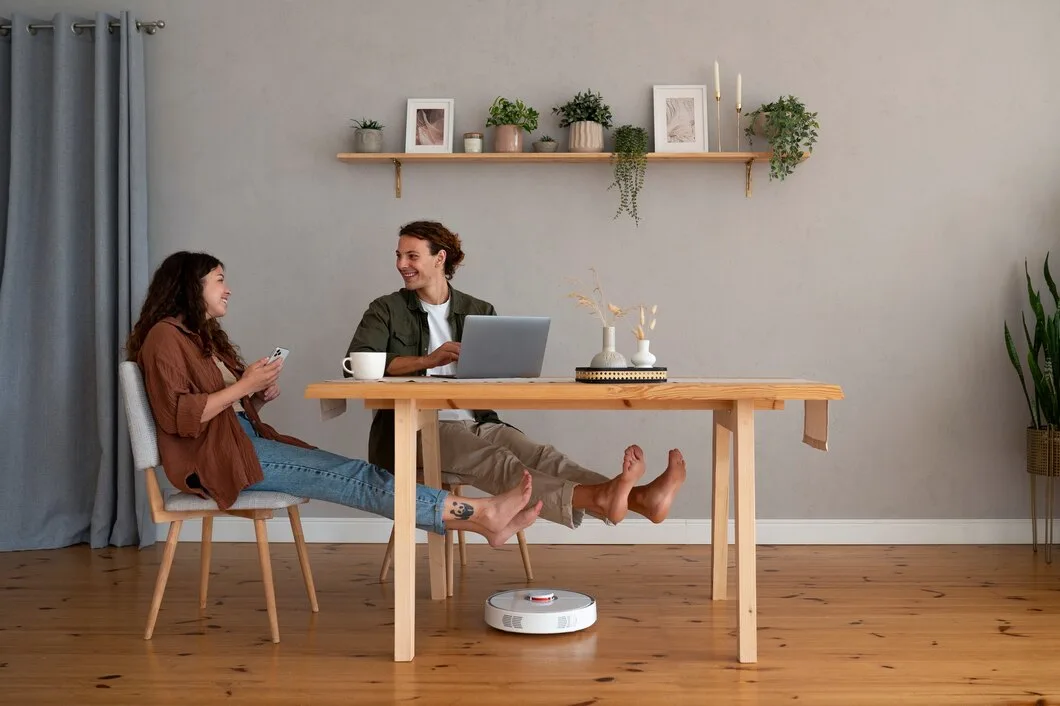
Most rooms do not need another screen, another speaker or another blinking status light. They need one or two objects that quietly remove a chore, and everything else is clutter with a power cable. The useful question when a new AI-branded device appears is not whether the technology is clever, but whether the room is better with it than without it.
Start With the Chore, Not the Category
The strongest smart home purchases begin with a complaint that already exists in the house. A hallway that is dark between eleven at night and six in the morning. A guest bedroom that runs three degrees colder than the rest of the floor. A back door that nobody remembers locking. Each of those is a specific, repeating irritation, and each has a device category attached to it.
The weakest purchases begin the other way around, with a category that sounds impressive and a search for a problem to justify it. Anyone who has lived with a voice assistant in a room where nobody talks to it knows the result. The hardware works exactly as advertised and still contributes nothing.
A practical filter for interiors work: write down the chore in one sentence before looking at any product. If the sentence is hard to write, the device is probably solving a manufactured problem.
What AI Actually Changes Inside a Device
The phrase covers very different things, and that matters when judging whether a claim is meaningful in a home setting.
- On-device recognition. A camera or doorbell that distinguishes a person from a passing cat, or a vacuum that recognises a charging cable and steers around it. This is the most mature and the most genuinely useful layer, because it reduces false alerts and avoidable accidents.
- Pattern learning. A thermostat or lighting controller that builds a schedule from observed behaviour instead of a form someone fills in once and never revisits. Useful in households with irregular routines, close to pointless in households that already run on a fixed timetable.
- Natural language control. Speaking a request in ordinary words rather than naming a scene. Genuinely helpful for accessibility and for guests who do not know the house’s naming conventions.
- Generative features. Suggested scenes, written summaries of what a camera saw, conversational assistants inside an appliance. The newest layer and the hardest to evaluate, because demonstrations are far more polished than daily use.
Sorting a product into one of those four buckets usually explains whether it will still be switched on in six months.
The Devices That Tend to Survive Year One
Across renovations and refits, a small group of categories keeps proving its worth, while a longer tail quietly ends up in a drawer.
| Device type | What it genuinely solves | Where it disappoints |
|---|---|---|
| Robot vacuum with obstacle recognition | Daily floor maintenance in homes with pets or children | Deep cleaning, thick rugs, cluttered floors |
| Learning thermostat and zone sensors | Uneven room temperatures and unnecessary heating hours | Poorly insulated rooms, where the fabric is the real issue |
| Video doorbell with person detection | Deliveries, access, false alerts from traffic | Anything requiring reliable night detail at distance |
| Motorised blinds on a schedule | Heat gain, glare, privacy in overlooked rooms | Rooms where the window shape fights the mechanism |
| Presence and leak sensors | Automation triggers, early warning under sinks and behind appliances | Nothing much, because expectations are modest |
| Smart mirrors and countertop assistants | Novelty and a talking point | Almost every daily routine they claim to improve |
The pattern is consistent. Devices that do one physical job well survive. Devices that mainly display information compete with the phone already in the owner’s pocket, and they usually lose.
Judging Build Quality When the Spec Sheet Is Loud
Interior specifiers learn to read a product the way they read a chair: material, finish, tolerance, serviceability. Connected hardware deserves the same scrutiny, because a device that will be in a room for five years is furniture whether or not it is marketed that way.
Worth checking before committing:
- Finish under real light. Gloss white plastic looks neutral in a product photograph and obvious on a warm oak shelf. Matte finishes and fabric wraps age better in domestic settings.
- Mounting and cable path. Anything that needs a visible adaptor halfway up a wall will be resented. Devices designed for in-wall or behind-furniture installation are worth the extra work.
- Replaceable parts. Filters, brushes, batteries and seals should be available separately. A sealed unit is a disposable unit.
- Local function without the cloud. A light switch that stops switching lights when the broadband drops is a design failure, not a connectivity issue.
- Noise. Fan noise, motor noise and notification chimes are judged in a quiet room at night, not in a showroom.
Where the Products Actually Come From
Anyone specifying connected hardware repeatedly ends up curious about the layer beneath the brand names. A large share of home devices in this space are built by contract manufacturers who produce comparable platforms for several labels, with differences concentrated in firmware, app quality, housing design and after-sales support rather than in the underlying module.
That is why two sensors with near-identical specifications can behave very differently in a real house, and why studios that buy in volume for rental portfolios, developments or retail ranges eventually look past consumer retail. Working through global sourcing hong kong channels puts a specifier in front of the manufacturers themselves, including OEM and ODM factories that will adjust a housing colour, a mounting plate or a packaging format for a mid-sized order. For a designer building a signature lighting or sensor package across multiple projects, that flexibility matters more than a discount.
The other reason to look upstream is timing. Categories move quickly, and the version of a device sitting on a retail shelf is often a generation behind what factories are already shipping to buyers.
Using a Trade Event as a Filter
Trade exhibitions are an unusually efficient way to compress a year of product research into a few days, because they allow direct comparison of devices that never appear side by side anywhere else. The Global Sources Hong Kong Shows run at AsiaWorld-Expo from 11 to 21 October 2026 in two phases, with mobile electronics, smart home, security and appliances, lifestyle products and sports and outdoor gathered in the second phase from 18 to 21 October. That phase alone brings together more than 2,100 suppliers across some 4,000 booths, with more than 1,200 AI-themed booths spread across seven segments.
For anyone building a view of where domestic technology is heading, the published round-ups of AI gadgets for home are a reasonable way to see which categories are getting serious factory attention rather than marketing attention. Across both phases the event covers more than 4,200 suppliers, 8,000 booths and over 330,000 new products in more than 26 categories, and buyer pre-registration has risen 25 percent year on year, with the strongest growth coming from Europe and North America. October 2026 also introduces a Future-Tech Discovery Zone and a first circular-economy pavilion featuring certified used phones meeting EU WEEE standards, which is a signal worth reading for anyone thinking about the lifespan of the hardware they specify.
A Short Checklist Before Anything Is Installed
- Does the device solve a chore that was already written down?
- Does it keep its core function when the internet is down?
- Can it be serviced, or is it sealed?
- Does it look acceptable switched off, which is most of the time?
- Is there a plan for what happens when the app is discontinued?
The last question is the one most often skipped and the one most likely to matter. Software support windows are shorter than the life of a room, and a device that becomes decorative when its app is retired should be cheap enough to treat as consumable.
The Quiet Version Wins
The best AI-assisted homes do not look technological. Blinds move before the afternoon sun hits the sofa, the hallway lifts to a low warm level at two in the morning, the heating gives up on an empty guest room, and nobody in the house can point to the device responsible. That invisibility is the real standard. Anything that demands attention in order to prove its value has failed the room test, however impressive the specification sheet looks.