
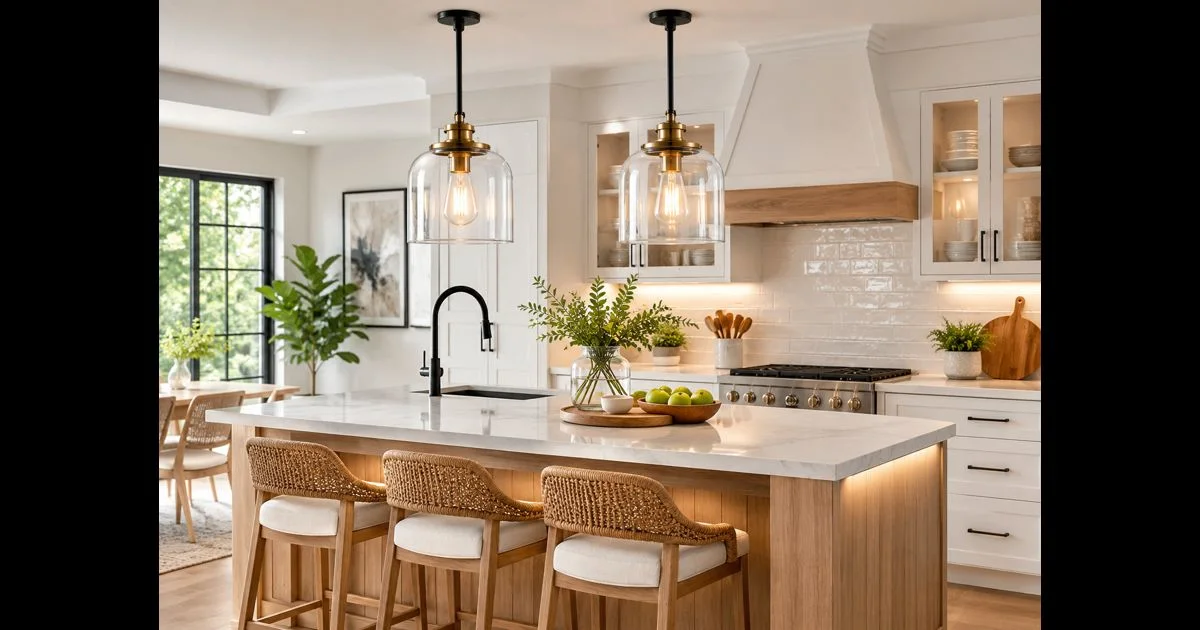
Kitchen islands do more than add extra counter space. In many homes, they become the visual center of the kitchen, the place where people prepare food, gather with family, answer emails, or sit with a cup of coffee before the day begins. Because of that, the lighting above an island has to do two things at once: provide useful illumination and help the island feel intentional within the overall design.
That balance is where many people get stuck. Pendant lights are often the most attractive option, but they can also make a kitchen feel crowded if the scale, spacing, or style is wrong. The goal is not simply to hang something beautiful above the island. The goal is to choose lighting that feels proportionate, practical, and visually calm.
A well-planned pendant arrangement can make a kitchen look more finished and more comfortable to use. A poor one can create clutter, block sightlines, or leave the work surface darker than expected. Understanding a few core principles makes the decision much easier.
Why Pendant Lights Work So Well Above Kitchen Islands
Pendant lights have a very specific strength: they define a zone. Unlike a central ceiling fixture, which spreads light more generally across the room, pendant lights focus attention downward. This gives the island a stronger identity and makes the kitchen feel more structured.
They are especially useful in open-plan layouts, where the island often acts as the visual bridge between cooking, dining, and living space. In those homes, lighting is not just practical. It also helps organize the room without adding walls or partitions.
Pendant lights over an island usually add three benefits at once:
- better task lighting for prep work
- stronger visual focus in the middle of the kitchen
- a more finished, design-led appearance
That combination is why they remain one of the most popular kitchen lighting choices, especially when homeowners are exploring pendant lighting options for kitchen islands that balance style and practicality.
The Most Common Reason Pendant Lights Feel Too Heavy
In most cases, overcrowding happens because the fixtures are too large, too numerous, or too visually dense for the size of the island.
People often choose pendants the way they choose decorative objects: by what looks impressive on its own. But pendant lighting should be judged in context. A fixture that looks elegant in a showroom may feel oversized once it hangs above a modest island in a kitchen with average ceiling height.
The problem is not only physical size. Visual weight matters too. Dark metal shades, thick lantern frames, and bulky clustered designs all occupy more visual space than clear glass or slim-profile fixtures. Two pendants can have the same width and still feel very different once installed.
A Simple Way to Think About Proportion
The easiest way to make better decisions is to think in terms of proportion instead of trend.
A pendant should feel related to:
- the length of the island
- the width of the island
- the ceiling height
- the visual busyness of the kitchen
If the cabinetry, backsplash, and countertop already carry a lot of detail, simpler pendants usually work better. If the kitchen is minimal and clean-lined, the lighting can take on more decorative presence without overwhelming the room.
Quick proportional guide
| Island size | Suggested pendant approach | Best visual effect |
| Small island | 1 medium pendant or 2 compact pendants | Keeps the space open |
| Medium island | 2 balanced pendants or 1 slim linear fixture | Creates symmetry |
| Large island | 2–3 pendants or 1 linear statement fixture | Defines the island clearly |
This is not a rigid formula, but it is a useful starting point. The main idea is that the lighting should sit comfortably within the island’s footprint rather than stretching beyond it visually.
Single Pendants vs Multiple Pendants
One of the first practical decisions is whether to use one fixture or several.
Single pendant lighting works best when:
- the island is short or compact
- the kitchen is smaller overall
- the fixture has enough presence to anchor the space on its own
- the goal is a cleaner, less busy look
Multiple pendants work best when:
- the island is longer
- the kitchen is open-plan
- even lighting across the surface matters
- the design calls for rhythm and repetition
In many kitchens, two pendants are the sweet spot. They provide symmetry and adequate coverage without turning the ceiling line into a row of visual interruptions. Three pendants can work beautifully too, but only when the island length and room scale truly support them.
Style Matters More Than People Think
When homeowners imagine pendant lights, they often focus on category first: globe, lantern, cone, tube, drum. But style choice should really come after the broader kitchen character is understood.
A modern kitchen with flat-front cabinetry, pale surfaces, and minimal hardware often benefits from simpler pendant shapes. Clear glass, soft globe forms, or slim cylindrical fixtures usually feel more integrated in these spaces.
A more layered or traditional kitchen can support fixtures with stronger detail, such as framed lantern pendants, textured shades, or warm metallic finishes.
Pendant styles and where they usually work best
| Pendant style | Best fit | Why it works |
| Globe pendants | Modern, Scandinavian, transitional kitchens | Soft visual profile, light feel |
| Lantern pendants | Traditional, farmhouse, classic kitchens | Strong structure and presence |
| Linear pendants | Long islands, open-plan kitchens | Even coverage and clean geometry |
| Slim tube pendants | Minimalist kitchens | Low visual clutter |
| Drum pendants | Softer interiors, decorative kitchens | Broader silhouette, diffused feel |
The key is not to force contrast for its own sake. A pendant should either reinforce the kitchen style or introduce a subtle point of distinction, not fight the room.
Height and Spacing: The Details That Change Everything
Pendant height has a huge effect on whether the lighting feels polished or awkward. If fixtures hang too high, they lose focus and start to feel disconnected from the island. If they hang too low, they interrupt views across the kitchen and become visually intrusive.
A useful general guideline is to hang pendants around 30 to 36 inches above the island surface. That range tends to provide enough task lighting without closing off the room.
Spacing matters just as much. Pendants should not be pushed all the way to the ends of the island. Leaving comfortable margins on both sides usually creates a more refined result.
Good spacing usually means:
- enough room for each fixture to feel distinct
- no visual crowding in the center
- balanced empty space at the ends of the island
This is one of those areas where restraint almost always looks more expensive than trying to fill every inch.
How Bright Should Kitchen Island Pendants Be?
Pendant lights over an island should not be expected to light the entire kitchen by themselves. Their job is more focused than that. In most well-lit kitchens, pendants work as part of a layered system.
That usually means:
- ceiling lighting for general brightness
- pendants for island-focused light
- under-cabinet lighting for counters and task zones
This layered approach prevents the pendants from having to overperform. Instead of choosing extremely bright fixtures, you can choose lighting that feels visually appropriate while still supporting daily use.
Warm-neutral to neutral-white light is often the safest choice above a kitchen island. It keeps the area comfortable while still feeling clear enough for prep work.
When Minimalism Is the Better Choice
A lot of overcrowding comes from assuming the island lighting has to be dramatic. Sometimes the opposite is true.
In smaller kitchens especially, minimal pendant lighting often looks better than bold statement pieces. Slim fixtures, clear glass, lighter finishes, and open shapes help preserve visual space. This matters even more when the island sits close to upper cabinets, shelving, or a busy backsplash.
If the room already has strong design features, the lighting does not need to compete. It just needs to support them.
Common Mistakes to Avoid
A few mistakes appear again and again in kitchen island lighting projects:
- choosing pendants based only on appearance, not scale
- hanging fixtures too low
- using too many pendants for the island length
- ignoring the visual weight of shades and frames
- expecting pendants to replace all other kitchen lighting
- choosing a style that clashes with the rest of the kitchen
Most of these problems come down to one thing: treating pendants as isolated objects instead of as part of the room.
The Right Light Completes the Island
Pendant lights can make a kitchen island feel more useful, more intentional, and more visually complete. But they do that best when they are chosen with proportion and context in mind. The most successful kitchens are rarely the ones with the most dramatic fixtures. They are the ones where the lighting feels like it belongs.
When pendant lighting is sized correctly, spaced well, and matched to the style of the room, it adds clarity rather than clutter. And that is exactly what kitchen island lighting should do.
Pingback: Caribloop: A Journey Through Caribbean Culture and Island Life