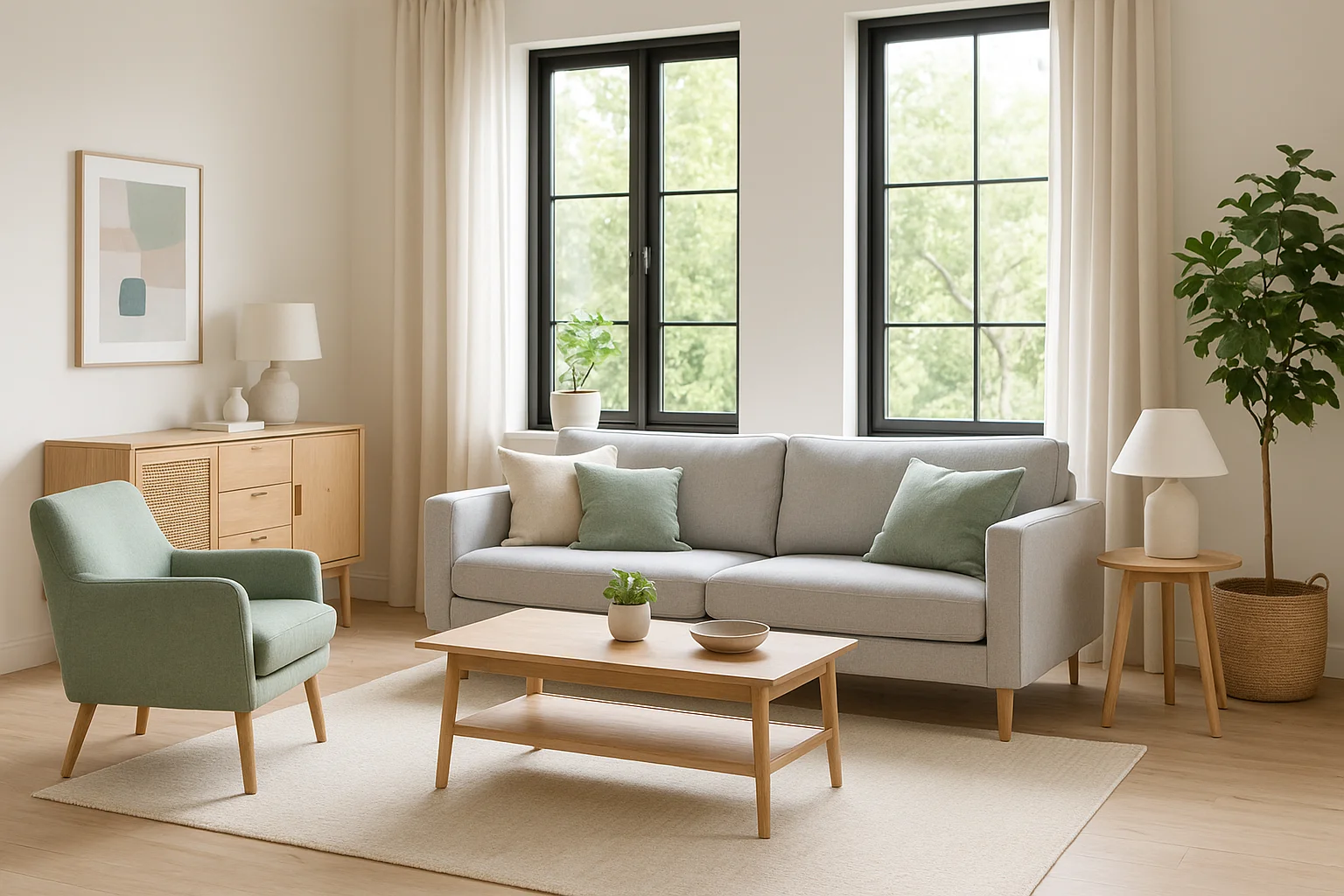
The sofa looked right in the listing. The dimensions made sense on paper. Then it arrived, and something was off — the back sat higher than expected, the colour read warmer under the room’s light, and the arms were heavier than the styled photograph had suggested.
This happens often enough that it has its own informal vocabulary among people who buy furniture online. Scale surprise. Colour drift. The piece that photographed well but landed wrong.
Most of the time the culprit is not the piece itself. It is how little the product page actually showed of it.
Why Furniture Is Easy to Misjudge Online
Listing dimensions tell you the footprint. They do not tell you how a piece will feel in the room, how its proportions will read against your actual ceiling height, or whether the visual weight of it will work with what is already there.
Product photography makes this harder. A wide-angle lens in a generous studio space produces a sense of openness that most real rooms do not have. Pieces look proportionate and airy in professional shots. In a normal apartment with standard ceiling heights and adjacent walls, the same object often reads quite differently. And the texture of upholstery, the depth of a wood grain, the way a metal finish catches light — all of this compresses into ambiguity at screen resolution.
A carved leg detail that matters to the character of a piece gets lost in a small image. Two chairs described identically on a listing can feel completely different in person. You are making decisions about things you have not fully seen.
What You Need to Understand Before You Buy
Proportion and scale
Beyond the millimetre figures on the listing, what matters is how a piece holds its shape visually. A high-backed chair can read as a statement in a low room in a way the product image does not hint at. A coffee table that photographs as elegantly slim may look undersized once it is sitting in front of an actual sectional. These are spatial judgments that require more than the front-facing hero shot.
Finish and texture
Natural linen comes in many different surface characters. So does oak, and so does brushed metal. The finish on a piece shapes whether it reads as warm or cool, refined or casual — and that affects whether it harmonises with your floors, your walls, and the other materials already in the room. Single studio photographs tend to flatten surface quality in ways that make comparison difficult. You often cannot tell what you are actually buying until it arrives.
The back profile
Pieces that will be visible from multiple directions — a dining chair pushed away from the table, a sofa sitting away from the wall, a statement lounge chair positioned centrally — have a character from behind that rarely appears in product listings. The rear leg profile of a chair can determine whether it looks tailored or slightly awkward from across the room. An upholstered back might be as considered as the front, or it might not. A standard listing image will not tell you.
Why More Than One Angle Changes What You Understand
For homeowners comparing shape, detailing, and proportion before buying, a 360 product viewer can make a furniture piece easier to assess than a single static image. Rotating a piece to check the rear profile, examining how a leg meets the floor, seeing the scale of hardware or stitching from the side — these are observations that would happen automatically in a showroom and are simply not available in a standard listing.
Some retailers have built this into their product pages, particularly for higher-consideration pieces. The practical effect tends to be fewer deliveries that disappoint. When someone can actually look at a piece from the angles that matter for their specific room, the gap between expectation and arrival narrows.
It does not replace handling the fabric or sitting in the chair. But it fills a different information gap — the spatial one — that photographs leave almost entirely open.
Reading a Piece Before It Arrives
Once you can rotate a piece and look at it properly, a few things tend to become clearer.
The silhouette from the side often tells you more about visual weight than the front view does. A sofa that looks lean from the front may have a deep back profile that reads as bulky when placed against a wall. A dining table that looks refined from a three-quarter angle may have an apron detail that makes it feel heavier in a small room.
Detailing becomes readable. The scale of a leg taper, the way an arm terminates on an upholstered chair, the join between a stretcher and a frame — these things matter to whether a piece reads as well-made or slightly generic, and they are almost impossible to judge from a single image.
And for pieces with long lead times or strict return policies — which describes a lot of quality furniture — arriving at that decision with more visual certainty is genuinely useful. The twelve-week wait for a custom sofa is a lot more comfortable when you feel you actually know what you ordered.
The Part That Still Depends on Knowing Your Room
Better viewing tools do their part. The other half belongs to you.
Before committing to anything with real presence in a room, it helps to spend time with the actual context. What does the light do in the room at different times of day? What floor, wall tone, and existing furniture does the new piece need to sit alongside? Is the piece going against a wall, or will it be seen from all sides? A warm oak finish may work beautifully against certain floors and fight others. A piece that photographs as neutral may carry an undertone that only becomes obvious once you hold a paint chip next to a material swatch.
Interactive viewing helps you understand the object. The room is still the variable that only you know.