Quick answer: Mycelium panels, recycled-glass surfaces and sculptural composites offer genuine aesthetic and sustainability value for interior cladding, but each carries distinct specification risks around moisture tolerance, fire classification, weight and lead time. Architects should treat sample aesthetics as a starting point, not a specification, and insist on technical submittals and full-size mock-ups before committing to volume orders.
A designer sits with a sample board, running a hand across a panel that looks like nothing else on the market — fibrous, matte, almost alive. It’s the kind of surface that makes a hospitality lobby or a boutique retail fit-out feel distinct. But the most compelling texture in the room is worthless if it can’t meet the fire classification the building control officer demands, or if the lead time blows past the contractor’s programme. Protecting the design intent means testing inspiration against the practical realities of specification, not the other way around.
Why is interior cladding becoming a material story?
Decorative cladding has shifted from a background finish to a storytelling device. Clients increasingly want surfaces with tactility, acoustic presence and a credible circularity narrative — something that signals brand values as much as it defines a room. It’s worth separating this category clearly from structural building elements: decorative cladding sits on top of a substrate, carrying visual and sensory weight rather than load. That distinction matters because it changes who signs off on performance, how the product is tested, and what questions a specifier needs to ask before a sample becomes a line item on a schedule.
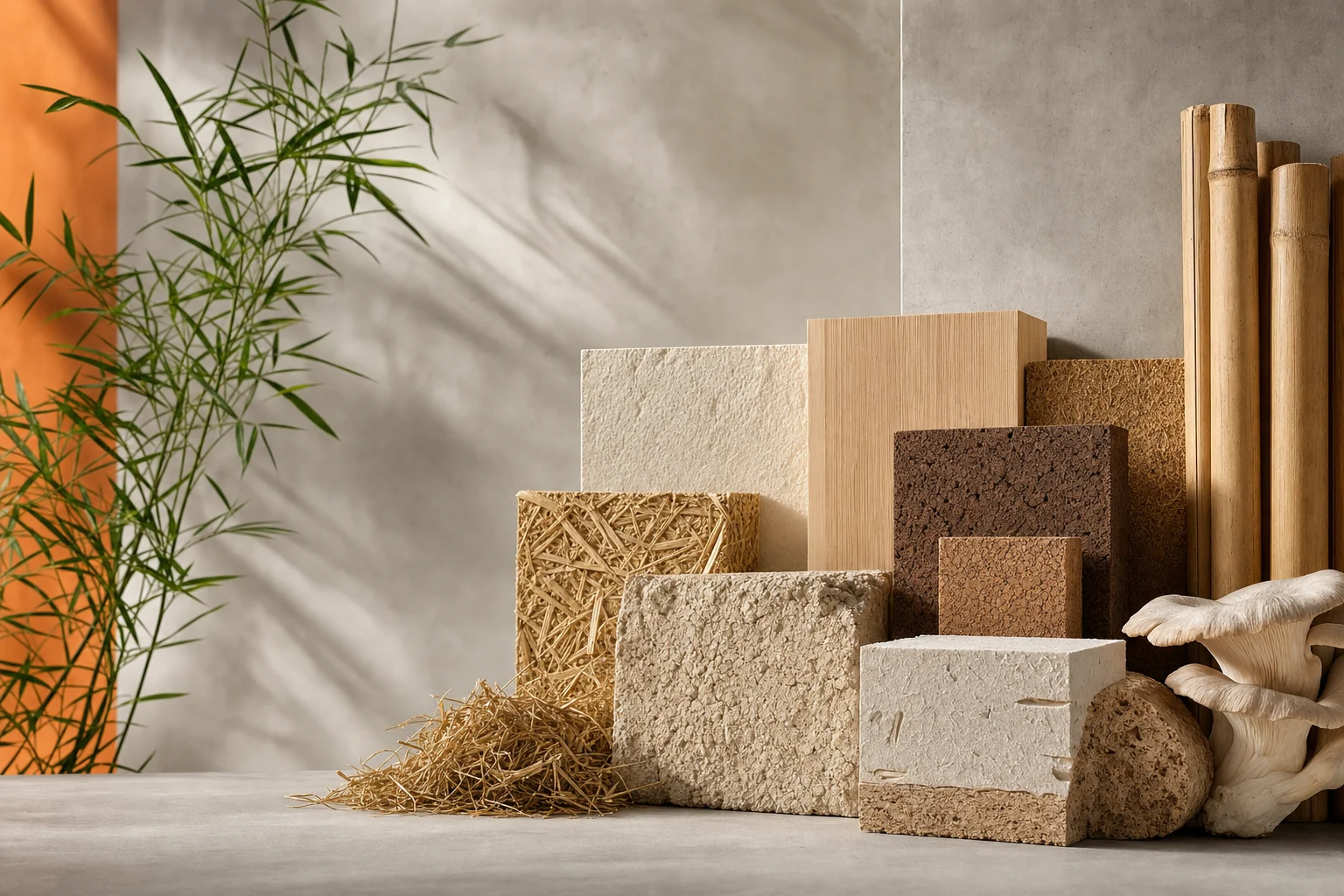
Three material directions are generating the most interest among architects right now as identified by BuiltUpEngg consultancy: mycelium-based bio-composites, recycled-glass surfaces, and sculptural or relief-moulded composites. Each deserves scrutiny on its own terms.
Can mycelium-based panels actually perform in a commercial interior?
Fungal mycelium acts as a natural binder, growing through an organic substrate — straw, wood fibre, agricultural waste — to form a lightweight, bio-based composite. The resulting panels can be grown into near-net-shape geometries, offering organic colour variation and a texture unlike any manufactured finish, with genuinely favourable acoustic characteristics in some formulations.
The open questions are technical, not aesthetic. Peer-reviewed research on mycelium-bonded composites gives a useful, if sobering, reference point. A 2026 study in Construction and Building Materials tested wheat-straw panels bonded with Ganoderma lucidum mycelium and found mechanical and thermal properties broadly comparable to low-density wood fibreboard, with fire behaviour that released less heat than conventional alternatives. The same research flagged a clear limitation: these composites absorbed significantly more moisture than wood-fibre products, particularly above 85% relative humidity, which raised concerns about long-term thermal performance and biological decay. It’s worth stressing that this study examined insulation-grade panels, not finished decorative cladding — but it illustrates the material class’s underlying behaviour, which any mycelium cladding supplier should be able to address directly.
Choose mycelium cladding if the brief prioritises a distinctive, bio-based texture in a dry, well-ventilated interior and the supplier can produce certified reaction-to-fire data and a credible cleaning and maintenance regime. Hold off if the application involves high humidity, frequent cleaning with moisture, or heavy traffic, until the supplier can demonstrate consistent, independently verified performance.
What should specifiers ask about recycled-glass cladding beyond the terrazzo look?
Recycled glass has moved well past the polished terrazzo floor. Aggregates can be set into resin or cementitious binders, fused into solid panels, or layered as composite sheets with a structural backing. Each production method behaves differently, and that difference matters more than the headline sustainability story.
Translucency and light reflection vary enormously depending on how the glass is graded, the resin or binder used, and the panel thickness. Edge treatment affects both the visual seam between panels and how robust those edges are in a high-traffic corridor. Weight is a frequently underestimated factor: a glass-aggregate panel can be considerably heavier than it looks, which has direct consequences for substrate preparation, fixing methods and installation sequencing.
Rather than relying on published weight or fire-class figures — which vary significantly between manufacturers and are rarely comparable across products — specifiers should request supplier-specific technical data sheets covering panel weight per square metre, recommended fixing systems, and Euroclass reaction-to-fire classification under EN 13501-1 before finalising a specification.
How do sculptural composites and 3D reliefs change under real lighting?
Moulded cementitious, mineral and composite panels bring the kind of waves, fluting and relief detail that a flat finish simply cannot deliver. The effect, though, depends entirely on lighting direction and module size. A sample chip lit under studio conditions can look completely different once installed under a raking light source in situ, where shadow depth and reveal lines either sharpen the form or flatten it.
Modular dimensions and joint strategy deserve early-stage design input, not late-stage value engineering. A panel size that reads beautifully on an elevation drawing may create awkward cut panels at corners or junctions once it meets real room dimensions. Early coordination with the supplier on module layout, reveal depth and lighting mock-ups protects the design intent long before the contractor is pricing installation.
A realistic material-selection scorecard
No single material wins across every criterion — and suitability on one project doesn’t automatically transfer to the next. Use a structured comparison to keep the conversation grounded:
| Criterion | Mycelium panels | Recycled-glass surfaces | Sculptural composites |
| Sample aesthetics | Organic, variable texture | Translucency and depth, variable finish | Strong relief and shadow play |
| Lead time | Ask supplier — production methods vary | Ask supplier — fabrication method dependent | Often longer for bespoke moulds |
| Substrate/fixing needs | Confirm with supplier; lightweight but moisture-sensitive | Confirm weight and fixing system per product | Module size drives fixing and joint detail |
| Acoustic performance | Potentially favourable; verify per product | Minimal inherent acoustic benefit | Depends on depth of relief and backing |
| Impact resistance | Needs independent verification | Varies by binder and thickness | Generally robust; confirm edge detail |
| Fire classification | Request EN 13501-1 Euroclass data | Request EN 13501-1 Euroclass data | Request EN 13501-1 Euroclass data |
| Maintenance | Confirm cleaning regime and moisture limits | Confirm cleaning agents compatible with binder | Generally low-maintenance |
| Environmental documentation | Request credible, product-specific evidence | Request credible, product-specific evidence | Request credible, product-specific evidence |
Treat every blank cell above as a question for the supplier, not an assumption to carry into the specification.
From mood board to approved mock-up
A compelling sample is the beginning of due diligence, not the end of it. A sample-led approval process should move through clear stages: initial sample requests to narrow the material direction, full technical submittals covering fire, weight, fixing and maintenance data, a full-size mock-up including corner and junction details, and a lighting test in conditions that mimic the finished space. Only once all parties — architect, contractor and client — have signed off on that mock-up should volume quantities be ordered.
This sequence exists precisely because experimental materials carry more unknowns than established products. For readers interested in the deeper material science behind bio-based and sustainable composites, the 2025 Journal of Materials Chemistry A is a useful point of reference for tracking where this research field is heading.
Testing inspiration against specification
Mycelium, recycled glass and sculptural composites each offer something flat, conventional finishes cannot: texture with a story, materiality with a conscience, and relief that changes with the light. None of that removes the need for a sample-led approval process, credible technical submittals and a full-size mock-up before volume purchase. The practices that get the most value from these materials are the ones that bring technical rigour to the mood board stage, not after the contract is signed.
Frequently asked questions
Are mycelium cladding panels suitable for bathrooms or wet areas?
Current research on mycelium-bonded composites shows elevated moisture absorption above 85% relative humidity, which can affect thermal performance and durability. Specifiers should request supplier-specific moisture testing before considering these panels for high-humidity interiors.
How heavy is recycled-glass cladding compared with standard finishes?
Weight varies significantly by binder type, aggregate density and panel thickness. There’s no reliable industry-wide figure, so request a product-specific weight-per-square-metre figure and confirm the fixing system with the supplier before finalising a substrate design.
What fire classification should I specify for experimental cladding materials?
Request Euroclass reaction-to-fire data under EN 13501-1, including smoke (s1–s3) and droplet (d0–d2) sub-classifications, directly from the supplier for the specific product and thickness being specified.
Can one approved sample guarantee consistency across a full project?
No. Natural materials like mycelium composites and recycled-glass aggregates carry inherent variation. A full-size mock-up, reviewed under representative lighting, gives a far more reliable benchmark than a small sample chip.
What’s the realistic timeline for specifying an experimental cladding material?
Lead times vary by supplier and production method and should be confirmed directly rather than assumed. Building in time for sample requests, technical submittals and a full-size mock-up protects the programme from late-stage surprises.