A small bedroom does not need to feel small. It needs a clear plan, furniture that earns its floor space, and a palette that lets light do the work. Most small bedrooms fail for the same reasons: a bed that is too large for the room, storage that stops at waist height, dark colours that close the walls in, and too many small objects competing for attention. Fix those four things and the same room feels calmer, brighter, and easier to live in.
This guide is about modern, everyday design, not a seasonal refresh. The ideas below work all year, in a rented flat or a home you own, and they work best when you apply them in order. Start with measurement, then layout, then colour, then storage, then light. Buying furniture first and measuring later is how small bedrooms end up cramped.
Start with the room, not the shopping list
Measure the room before you buy anything. Measure the length and width of the floor, the height of the ceiling, and the position of the door, the window, the radiator, and any sockets you actually use. Write the numbers down and keep them with you when you shop. A bed that looks right in a showroom can block a door or leave no room for a bedside table at home.
Measure the route in as well. A bed frame, a wardrobe, and a mattress all need to pass through the door, around the hallway turn, and into the room. If a piece cannot make that journey, its size in the room does not matter. This is the step people skip, and it is the step that causes the most returns and the most frustration.
Once you have the numbers, draw a simple plan on paper. Mark the bed first, because it is the largest piece and the one you cannot move easily. Leave a clear path from the door to the window and from the bed to the wardrobe. As general design guidance, aim for walkways of about 30 to 36 inches where you need to pass every day. A narrower gap might look fine on a plan, but it feels tight when you are carrying laundry or getting out of bed in the dark.
Choose a layout that leaves room to move
In a small bedroom, the bed usually belongs against the longest wall, with its headboard centred. That position leaves the most usable floor on both sides and keeps the window clear. Pushing the bed into a corner can save space on paper, but it makes one side hard to reach and makes changing the bedding a chore. If the room is very narrow, a corner position may be the only workable choice, and in that case keep the other side of the room completely clear.
Keep the centre of the room open. A small bedroom does not need a chair, a desk, and a dressing table as well as a bed. Choose one extra function at most, and give it a clear place. A small desk by the window can work. A reading chair in the middle of the floor will not. The same layout thinking that helps you make a small living room feel bigger applies here: clear paths, furniture against the walls, and nothing standing in the middle of the room without a job to do.
Think about what you see when you walk in. The first thing your eye meets sets the feeling of the room. If it is the side of a wardrobe or a pile of clothes, the room feels crowded before you have taken a step. If it is a made bed, a clear wall, and light from the window, the room feels calm. Arrange the layout so the tidy side of the room faces the door.
Pick a light palette — and keep it tight
Light colours reflect more light, and more light makes a small room feel larger. That is the whole secret of the light palette, and it works best when you commit to it. Choose warm white, soft cream, pale grey, or a light warm beige for the walls, and repeat those tones in the bedding and the curtains. A light, airy palette works in every season, and the same thinking shapes our summer bedroom ideas for the warm months, when light and airflow matter most.
Keep the palette to three main colours: one light base, one mid-tone for wood or upholstery, and one deeper accent used sparingly. A fourth or fifth colour usually turns a calm room into a busy one. The accent can be a cushion, a throw, or the art above the bed, but it should appear in one or two places only. If the same colour appears on the curtains, the rug, the bedding, and the lamp, it stops being an accent and becomes the room.
Paint the ceiling the same light colour as the walls, or one shade lighter. A white ceiling against dark walls draws a hard line around the room and makes the ceiling feel lower. A ceiling that blends with the walls lets your eye travel up without stopping. If you want colour on the walls, keep it to one wall behind the bed, and keep the other walls light. One strong wall adds character. Four strong walls shrink the room.
Make the bed work harder
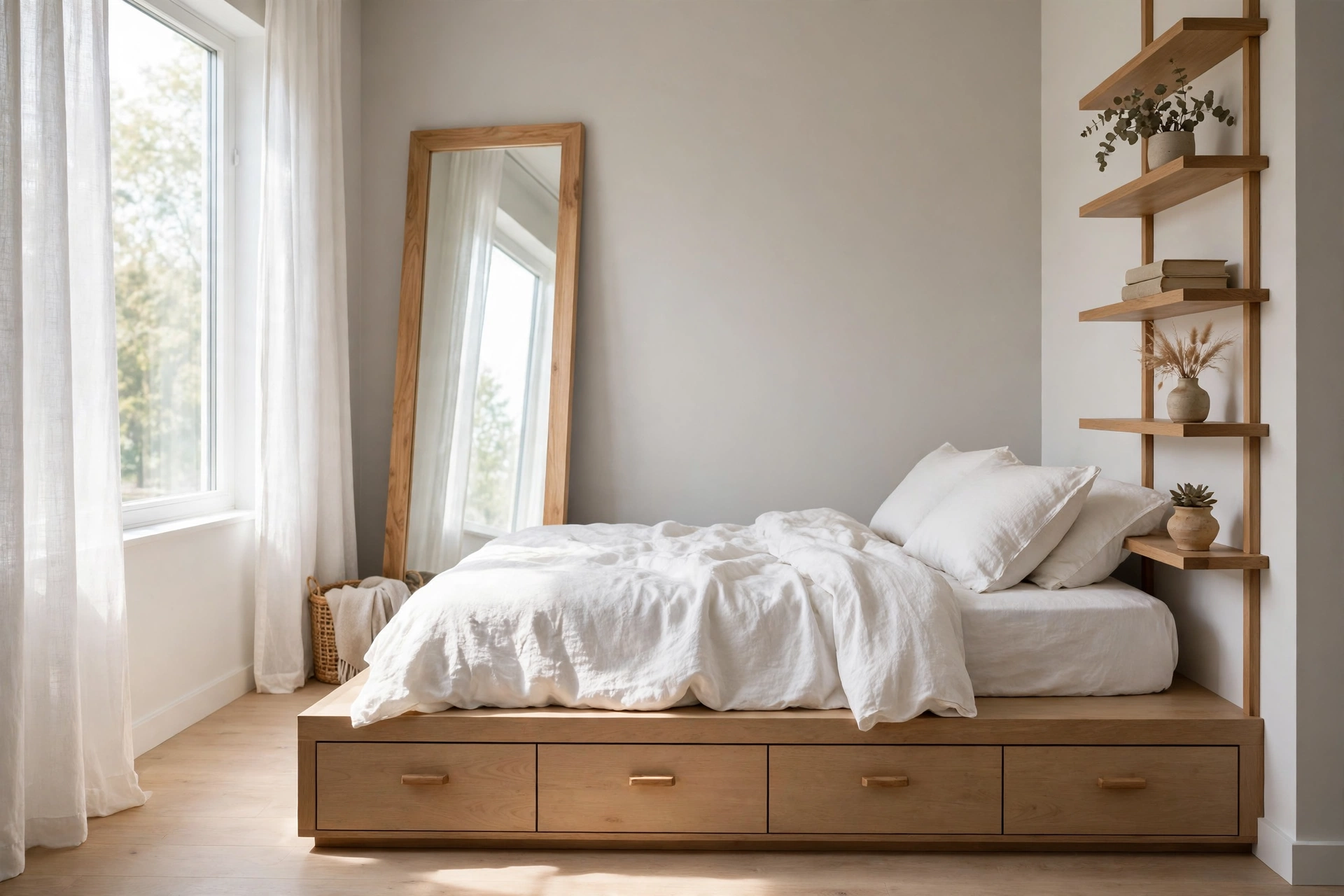
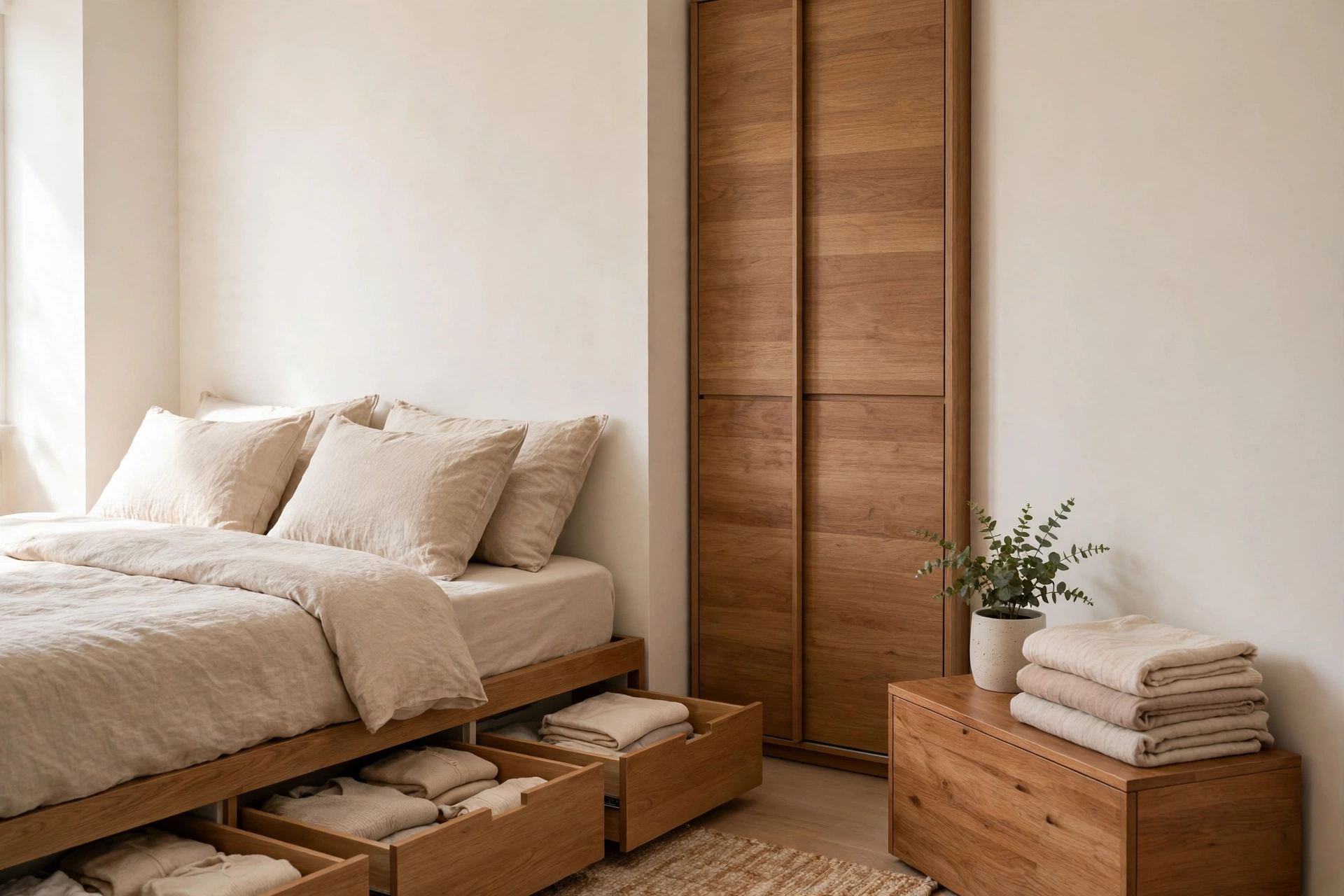
The bed takes up more floor than anything else in the room, so it should also hold more than anything else. A storage bed with drawers underneath turns dead space into useful storage for bedding, out-of-season clothes, and spare linen. Drawers are easier to use every day than a lift-up base, because you can open one drawer without lifting the mattress. Keep the drawers for things you use weekly, not for things you have forgotten you own.
Choose a low platform bed if the ceiling is low or the room is narrow. A low bed leaves more wall visible above it, and visible wall makes the room feel taller. A tall, heavy headboard has the opposite effect. A simple upholstered headboard in a light fabric, or a slim wooden headboard, gives the bed a finished look without adding visual weight.
Keep the bedding simple. One light duvet cover, two sleeping pillows, and one extra cushion are enough. A pile of cushions looks inviting in a photograph and takes up half the bed in real life. Fold a throw across the foot of the bed instead of layering three blankets. The bed should look ready to sleep in, not ready to be photographed and then cleared.
Go vertical with storage
When floor space runs out, the only direction left is up. Floor-to-ceiling storage uses the full height of the wall and leaves the floor clear, which is exactly what a small bedroom needs. A tall, slim wardrobe holds more than a wide, low chest of drawers, and it takes up less of the room. Keep the wardrobe doors plain and light, and the wardrobe will read as part of the wall rather than as a large piece of furniture.
Sliding doors are worth considering for the wardrobe and for the bedroom door itself. A hinged door needs a clear arc of floor to open, and in a small room that arc is often the most useful part of the floor. A sliding door needs no arc at all. The same applies to a wardrobe: sliding doors let you open one side without blocking the walkway in front of it.
Use floating shelves for the things you want to see and reach, and closed storage for everything else. A shelf above the bed can hold books and a small plant. A shelf that runs the length of one wall can hold the same, but it needs to be kept light. If a shelf is full from end to end, it stops looking like storage and starts looking like clutter. Leave space on every shelf, and leave one shelf partly empty on purpose.
Store by frequency. Everyday clothes belong at arm height. Bedding and spare towels belong higher up or under the bed. Things you use once a year belong in the hardest place to reach, not in the drawer you open every morning. When everything has a place that matches how often you use it, the room stays tidy without constant effort.
Use mirrors with intent
A mirror is the cheapest way to make a small bedroom feel larger, but only when it is placed with intent. Hang a large mirror opposite the window, or beside it, so it reflects daylight and the view outside. A mirror that reflects a blank wall or the inside of a wardrobe does nothing for the room. As general design guidance, a mirror at least 4 feet tall has the strongest visual effect, because it reflects the room at eye level when you are standing and sitting.
One large mirror works better than several small ones. A wall of small mirrors breaks the reflection into pieces and makes the wall feel busy. A single tall mirror, a mirrored wardrobe door, or a large leaning mirror gives one clear reflection and one calm surface. Keep the frame slim and light, and keep the glass clean. A dusty mirror reflects a dull room.
Do not put a mirror where it reflects the bed directly if that bothers you at night. Place it on the wall beside the bed, or on the wardrobe, so you get the light and the sense of space during the day without the reflection facing you while you sleep. Good mirror placement is about the daytime feeling of the room, not about filling a blank wall.
Choose low-profile furniture
Low furniture shows more wall and more floor, and both make a room feel bigger. A low bedside table, a low chest of drawers, and a low bed frame all help. Furniture with slim legs helps even more, because you can see floor underneath it. A solid block of furniture that sits flat on the floor reads as heavy. The same piece on short legs reads as light.
Choose furniture that makes small rooms look larger by showing more floor and keeping its lines simple. Look for furniture that makes small rooms look larger: slim arms, flat fronts, no heavy ornament, and a finish that matches the room rather than fighting it. One well-chosen piece is better than three pieces that each try to be the centre of attention.
Measure every piece against the room, not against the shop floor. Oversized furniture fails the same way in any small room, whether it is a bed or an L-shaped reclining sectional squeezed into a corner it was never made for. If a piece leaves less than a comfortable walkway, or blocks a drawer or a door, it is too large for the room, however much you like it. A smaller piece that fits well always looks better than a larger piece that does not.
Use one bedside table instead of two when the room is tight. A single table on the side you use most, with a small lamp and a book, is enough. The space you save can hold a laundry basket out of sight, or simply stay empty. Empty floor is not wasted floor in a small bedroom. It is the space that lets the room breathe.
Layer the lighting
One ceiling light in the middle of the room is not enough for a small bedroom, and it is often too harsh. Layer the light instead: a soft ceiling light for general use, a bedside lamp for reading, and a low, warm light for the evening. Each layer should be easy to switch on separately, so you can choose bright light for cleaning and soft light for winding down.
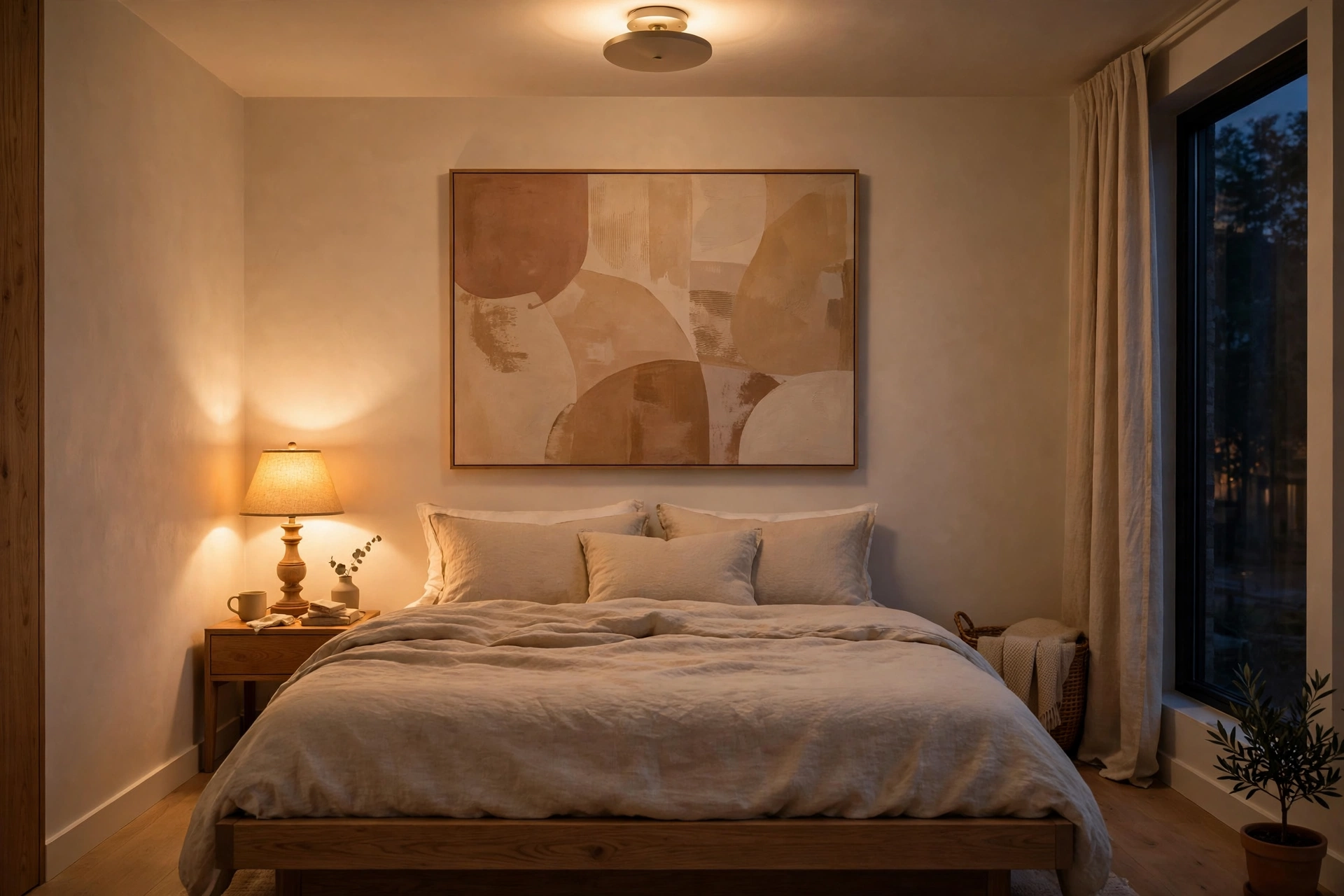
Keep the light warm in the evening. A warm bedside lamp makes the room feel calm and makes the bedding look soft. A cold, bright light makes the same room feel like an office. If your ceiling light feels too strong, a simple shade that softens it will change the whole room. You do not need new wiring to fix bad lighting. You need a shade, a lamp, and a lower, warmer glow.
Use the window as your main daytime light. Keep the curtains light and hang them high and wide, so the full window is clear when they are open. Heavy curtains that cover half the window block the light the room needs most. A sheer curtain that lets daylight through, with a heavier curtain you can close at night, gives you light during the day and privacy after dark.
Get the rug size right
A rug that is too small makes a bedroom feel smaller, because it breaks the floor into pieces. A rug that is large enough to sit under the front legs of the bed and extend past its sides pulls the bed, the floor, and the room together. The rug should be wide enough that you step onto it when you get out of bed, not onto bare floor beside a small mat.
Choose a low, flat rug in a light, plain colour. A thick, patterned rug adds visual noise and makes the floor feel busy. A plain rug in a soft tone lets the bed and the walls do the talking. If you already have a rug you like, check its size before you buy anything else for the room. Getting the rug size right matters more than getting a new cushion, and choosing the right rug for your bedroom starts with measuring the bed and the floor around it, not with choosing a pattern.
Leave some floor visible around the rug. A rug that covers the whole floor makes the room feel carpeted and heavy. A rug with a border of floor showing on all sides looks deliberate and keeps the room feeling light. The border does not need to be wide. A few inches of visible floor on each side is enough.
Add one statement piece, then stop
Every small bedroom needs one thing that makes it yours. It can be a large art piece above the bed, a handmade lamp, a woven throw, or a plant in a plain pot. Choose one, give it a clear place, and let it be the focus. When everything in the room tries to be interesting, nothing is.
Hang the art at eye level, centred above the bed, and keep it to one piece. A gallery wall of small frames suits a large living room. In a small bedroom it fills the one wall you have with many small decisions. One large, calm piece of art, in colours that match the room, will do more for the space than five small ones.
Keep the other surfaces quiet. A bedside table with a lamp and a book, a shelf with a plant, and a made bed are enough. If you add a new object, remove one. That simple rule keeps a small bedroom from filling up again after you have worked hard to clear it.
Keep clutter under control every day
A small bedroom does not stay tidy by itself. It stays tidy because everything has a place and because the daily reset takes five minutes. Make the bed in the morning. Put clothes away instead of leaving them on a chair. Clear the bedside table before you sleep. These small habits matter more in a small room than in a large one, because there is nowhere for clutter to hide.
Use a few simple rules to keep the room in shape:
- One in, one out: when a new cushion, book, or piece of clothing arrives, an old one leaves the room.
- Clear surfaces: keep the top of the chest of drawers and the bedside table mostly clear, with one or two objects only.
- Hidden storage: keep everyday clutter in a drawer or a basket, not on the floor or on the bed.
- Weekly check: once a week, walk into the room and remove anything that does not belong there.
A tidy small bedroom feels larger than a cluttered large one. The room has not changed size. Your eye simply has less to trip over, and the light has a clear path across the floor and the walls.
A simple plan to start this weekend
You do not need to redo the whole room at once. Start with the steps that cost nothing and change the feeling of the room the most. Measure the room and move the bed to the longest wall. Clear one surface completely. Take down the small pictures and keep the largest one. Open the curtains fully and see how much light the room actually gets.
Then make one change at a time. A storage bed, a large mirror, or a new rug each make a visible difference on their own. Give each change a week before you make the next one, so you can see what it does to the room. A small bedroom improves fastest when you change one thing, live with it, and then decide what the room still needs.
The goal is not a room that looks perfect in a photograph. The goal is a room that is easy to sleep in, easy to keep tidy, and calm to wake up in. Light colours, a clear layout, storage that uses height, and lighting you can soften in the evening will get you there. Keep the palette tight, keep one statement piece, and let the empty space do its work.
Frequently asked questions
What is the best layout for a small bedroom?
Put the bed against the longest wall with its headboard centred, keep the centre of the room open, and leave clear walkways of about 30 to 36 inches where you pass every day. Keep the path from the door to the window clear, and let the tidy side of the room face the door.
What colours make a small bedroom look bigger?
Warm white, soft cream, pale grey, and light warm beige make a small bedroom look bigger because they reflect more light. Keep the palette to three main colours, paint the ceiling the same light colour as the walls or one shade lighter, and use a deeper colour only as a small accent.
How do I add storage to a small bedroom without crowding it?
Use the bed and the height of the walls. A storage bed with drawers uses the space under the bed, and a tall, slim wardrobe uses the full height of the wall while leaving the floor clear. Keep everyday items at arm height, use closed storage for clutter, and leave space on every shelf.
Where should I put a mirror in a small bedroom?
Hang one large mirror opposite or beside the window so it reflects daylight and the view outside. A mirror at least 4 feet tall has the strongest effect because it reflects the room at eye level. Avoid a mirror that reflects only a blank wall, and avoid one that faces the bed directly if that bothers you at night.
What size rug should I use in a small bedroom?
Use a rug large enough to sit under the front legs of the bed and extend past its sides, so you step onto it when you get out of bed. Choose a low, flat rug in a light, plain colour, and leave a small border of floor visible around it.
How can I make a small bedroom feel cosy without making it cluttered?
Layer warm lighting, use soft linen bedding, and add one statement piece, such as a large art piece above the bed. Keep the palette tight and the surfaces mostly clear. Cosiness comes from warm light and soft texture, not from filling the room with objects.