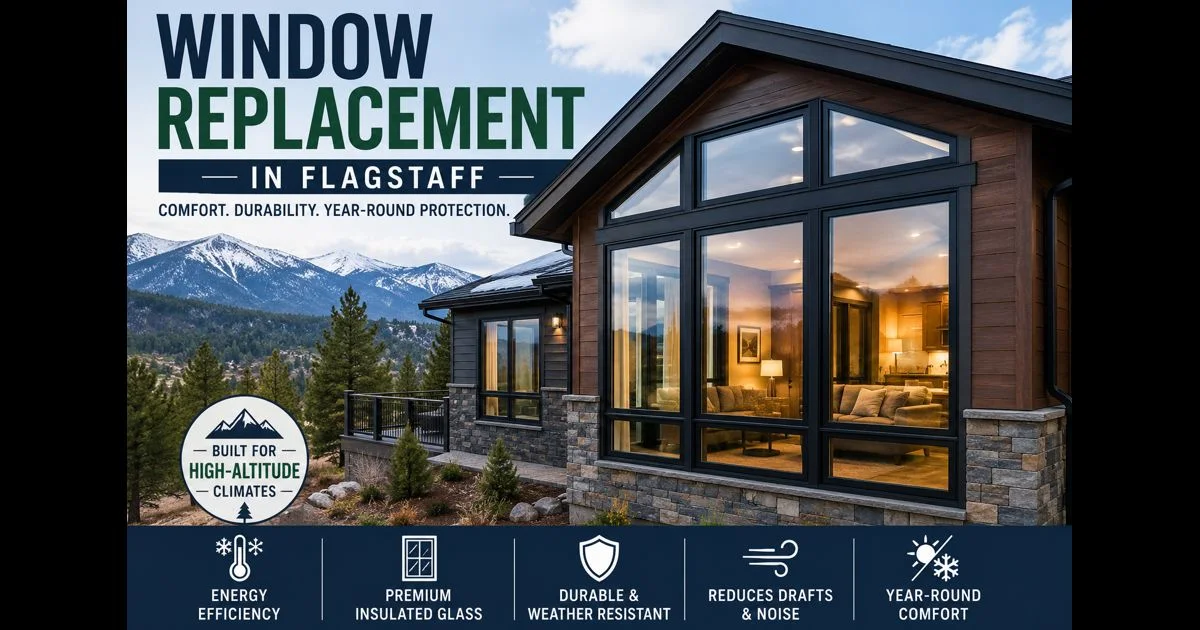
Windows affect much more than the appearance of a home. They influence indoor comfort, natural light, ventilation, noise control, and the amount of heat that enters or escapes through the building envelope.
Choosing replacement windows can be especially challenging in Flagstaff. Unlike lower-elevation areas of Arizona that are dominated by long periods of extreme heat, Flagstaff homes must perform through cold winter temperatures, snow, strong sunlight, dry conditions, seasonal storms, and considerable temperature changes between day and night.
A window that performs well in a hot desert climate may not necessarily be the best choice for a high-altitude Northern Arizona property. Homeowners need to consider the complete window system, including the glass, frame, spacers, seals, installation method, and orientation of each opening.
Understanding these factors can help homeowners compare products more effectively and avoid choosing windows based only on appearance or price.
How Flagstaff’s Climate Affects Residential Windows
Windows form part of the barrier between conditioned indoor space and outdoor weather. When that barrier becomes inefficient, a home may experience drafts, uncomfortable rooms, condensation, air leakage, or excessive heat transfer.
Flagstaff’s climate creates several different performance demands.
During colder periods, windows need to limit indoor heat loss. During sunny days, glass must also manage solar energy and ultraviolet exposure. Seasonal storms can test exterior seals and drainage, while repeated temperature changes can affect frames, sealants, and insulated glass units.
National Weather Service data for Flagstaff show substantial differences between normal daytime and nighttime temperatures, even during summer. This daily temperature variation places repeated thermal stress on exterior building materials.
Window selection should therefore account for both winter insulation and summer solar control rather than treating Flagstaff as a purely heating- or cooling-dominated environment.
U-Factor Is Important in a Cold-Winter Climate
The U-factor measures how readily heat passes through a complete window assembly. Lower U-factor values indicate better resistance to heat transfer.
For Flagstaff homeowners, this rating is especially relevant during winter. Windows with poor insulating performance can allow indoor heat to move toward the colder exterior, contributing to uncomfortable areas near the glass.
When comparing products, homeowners should look for the whole-window U-factor rather than a rating that applies only to the center of the glass.
The whole-window rating accounts for:
- Glass
- Frame
- Sash
- Spacers
- Edge-of-glass performance
- Other components within the tested window assembly
The U.S. Department of Energy recommends evaluating whole-unit U-factor and solar heat gain coefficient ratings because they provide a more accurate representation of the complete product.
A low U-factor does not guarantee that every installation will perform equally well. Gaps around the frame or inadequate insulation around the opening can undermine the performance of an otherwise efficient window.
Solar Heat Gain Should Be Evaluated by Orientation
Solar heat gain coefficient, commonly abbreviated as SHGC, indicates how much solar radiation passes through a window and becomes heat inside the home.
A lower SHGC reduces solar heat gain. That can be useful for windows receiving intense summer sun, particularly on western and southern exposures.
However, the ideal rating may not be identical for every side of a Flagstaff home. Some homeowners may value controlled winter solar gain through appropriately oriented windows, while still needing stronger solar protection on exposures that become excessively hot during summer afternoons.
This means window orientation should be considered during product selection.
Questions to evaluate include:
- Which windows receive direct afternoon sun?
- Are any openings shaded by trees or roof overhangs?
- Do certain rooms become too warm during summer?
- Are north-facing rooms noticeably colder in winter?
- Is glare a problem in working or living areas?
- Are furnishings or floors showing signs of fading?
The Department of Energy notes that low-emissivity coatings can be designed for high, moderate, or low solar gain, allowing different products to address different climates and orientations.
Low-E Glass Helps Control Heat Transfer
Low-emissivity, or low-E, glass contains a very thin coating designed to control infrared heat transfer while allowing visible light to pass through.
Different low-E configurations serve different purposes. Some are designed primarily to retain indoor heat, while others focus more heavily on reducing incoming solar heat.
Low-E coatings can also reduce the amount of ultraviolet radiation reaching interior furnishings, flooring, artwork, and fabrics.
Homeowners should not assume that every low-E window provides the same performance. The position and type of coating, number of panes, gas fill, spacer system, and complete glass package all influence the final rating.
When comparing options for window replacement in Flagstaff, AZ, homeowners should ask for the actual U-factor and SHGC rather than relying only on general terms such as “energy-efficient glass.”
Double-Pane and Triple-Pane Windows
Most modern replacement windows use insulated glass units containing two or more panes separated by a sealed space.
Double-Pane Windows
Double-pane windows are widely available and may provide a substantial improvement over older single-pane or poorly sealed windows.
Their performance depends on:
- Glass coatings
- Distance between panes
- Spacer design
- Gas fill
- Frame quality
- Overall construction
A high-quality double-pane window may provide suitable performance for many Flagstaff homes when it is selected and installed correctly.
Triple-Pane Windows
Triple-pane windows add another layer of glass and another insulating space. They may provide lower U-factors, improved interior-surface temperatures, and additional sound reduction.
However, triple-pane units are heavier and normally cost more. The potential benefit should be evaluated against the home, exposure, existing windows, heating system, and project budget.
The number of panes should not be considered in isolation. A well-designed double-pane product may perform better than a poorly constructed triple-pane window.
Frame Material Influences Performance and Maintenance
Window frames are available in several materials, each with different strengths.
Vinyl Frames
Vinyl windows are commonly selected because they require relatively little maintenance and can offer good thermal performance.
Quality can vary considerably. Homeowners should evaluate frame construction, internal reinforcement, corner joints, drainage features, and resistance to movement.
Fiberglass Frames
Fiberglass is dimensionally stable and can provide good insulating performance. It may be appropriate for properties exposed to wide temperature changes.
Fiberglass windows may cost more than many standard vinyl products, so homeowners should compare the total product and warranty rather than frame material alone.
Wood and Clad-Wood Frames
Wood provides a traditional interior appearance and can offer good insulating properties. Exterior cladding may reduce the maintenance required on exposed surfaces.
Wood products still need to be evaluated for moisture exposure, finish requirements, and long-term maintenance.
Aluminum Frames
Aluminum is strong and can support narrow profiles, but it conducts heat readily. Modern thermally improved aluminum systems use barriers intended to reduce heat transfer through the frame.
The best material depends on the home’s design, opening size, exposure, desired appearance, maintenance expectations, and budget.
Signs That Existing Windows May Need Replacement
Not every older window requires immediate replacement. Some problems may be corrected through adjustment, weatherstripping, glass repair, or maintenance.
Replacement becomes more likely when several performance problems appear together.
Common warning signs include:
- Drafts around closed windows
- Windows that are difficult to open or lock
- Condensation or fogging between panes
- Cracked or deteriorated frames
- Water stains around an opening
- Recurring exterior sealant failure
- Significant indoor temperature differences near windows
- Excessive outdoor noise
- Loose or damaged sashes
- Single-pane glass in frequently occupied rooms
- Air or dust entering around the frame
- Windows that no longer remain open safely
Condensation on the room-facing surface does not always mean the window has failed. Indoor humidity and outdoor temperature can also cause surface condensation.
Fogging or moisture trapped between the panes is more likely to indicate failure of the insulated glass seal.
Full-Frame Replacement Versus Insert Installation
The installation method can be just as important as the window itself.
Insert Replacement
An insert window is installed within an existing frame. This approach may preserve surrounding interior and exterior finishes and can reduce the amount of construction work required.
Insert replacement is most appropriate when the original frame remains structurally sound, square, and free of significant water damage.
Because the new unit fits inside the old frame, the visible glass area may become slightly smaller.
Full-Frame Replacement
Full-frame replacement removes the existing window down to the rough opening.
This allows the installer to inspect concealed areas, correct damaged materials, install new flashing, and rebuild the opening as needed.
Full-frame replacement may be more appropriate when:
- The frame is deteriorated
- Water has entered around the opening
- The existing window was installed incorrectly
- The opening is no longer square
- The homeowner wants to change the window style
- The maximum available glass area is important
The correct method should be selected according to the condition of the opening rather than automatically using the same approach throughout the property.
Installation Determines Whether the Window Performs Properly
Energy ratings are based on tested window assemblies. They do not account for poor installation around the product.
A window can have strong published ratings and still develop problems if it is:
- Measured incorrectly
- Installed out of square
- Fastened unevenly
- Insulated inadequately
- Flashed incorrectly
- Sealed with unsuitable materials
- Installed without proper drainage
Incorrect installation may cause difficult operation, air leakage, water intrusion, damaged finishes, or premature seal failure.
The live Windows N More Flagstaff page correctly emphasizes that even strong products can underperform when they are not installed properly. The company offers replacement-window and door services in the Flagstaff area.
Compare Complete Products, Not Marketing Claims
Terms such as “high efficiency,” “premium,” and “insulated” do not provide enough information to compare windows accurately.
Homeowners should request:
- Whole-window U-factor
- Whole-window SHGC
- Air-leakage rating
- Visible-transmittance rating
- ENERGY STAR climate-zone qualification
- Frame and glass warranties
- Labor warranty
- Glass-breakage coverage, when available
- Details about installation materials
- Information about service after installation
ENERGY STAR recommends choosing windows according to the climate where they will be installed and reviewing their U-factor and SHGC ratings.
The lowest-priced proposal may not provide the best long-term value if it uses a weaker glass package, limited warranty, or installation method unsuitable for the existing openings.
A Room-by-Room Approach Can Produce Better Results
Every window in a home does not necessarily need the same configuration.
A better selection process considers how each room is used.
For example:
- A bedroom may benefit from improved sound control and secure ventilation.
- A living room may prioritize large glass areas and views.
- A south- or west-facing room may need stronger solar control.
- A bathroom may require privacy glass and moisture-resistant materials.
- A hard-to-reach window may need a simpler operating style.
- A kitchen window must remain easy to use around counters or sinks.
Homeowners should also consider whether changing the window style would improve ventilation, cleaning, safety, or furniture placement.
Choosing Replacement Windows for Long-Term Performance
The best replacement window is not defined by one material, brand, or performance number.
A successful project combines:
- A product suited to Flagstaff’s climate
- Appropriate U-factor and SHGC ratings
- A frame selected for the opening and exposure
- Glass options suited to each room
- Correct measurement
- Proper installation and flashing
- Effective air sealing
- A clear product and labor warranty
Homeowners comparing Flagstaff window replacement services should ask how the proposed windows address both cold-weather insulation and warm-season solar gain.
Plan Around the Home, Not Only the Window
Replacing windows is an opportunity to improve comfort and correct problems that may have existed for years. However, the project should begin with a careful evaluation of the home rather than a quick product selection.
Orientation, elevation, existing frame condition, room use, winter heat loss, summer sunlight, and installation quality all affect the final result.
Windows N More provides window and door replacement in Flagstaff and other Northern Arizona communities. Its Flagstaff services include replacement windows, energy-efficient options, sliding glass doors, and products from established manufacturers.
By reviewing performance ratings and installation details carefully, Flagstaff homeowners can select windows that remain comfortable, functional, and appropriate for the local climate.